Thursday, 23 March 2017
Newfoundland to Australia NON STOP...
Not so much an update from us but after a long wait the account of Trevor Robertson's journey from Newfoundland to Australia has been written up and posted. Create some space, settle down and read an entertaining write up of a great trip. Remarkable.
Click here to read..


Wednesday, 11 January 2017
Stick in the muds.............

How quickly the months slide by and I search around for excuses. Little point in blaming the Christmas/holidays as we neither celebrate Christmas in any form and, it may be argued, we’re permanently on holiday. Whatever, nowt has been written but we have continued with our life afloat. Here’s where we currently are.
 |
| How we spend most of the day.... |
As we had had such a
successful winter “refit” we opted to get back into the water
rather than spend the time on the hard and we duly recruited Nick, on a sister-ship to Hannah and
from the quay we were heading for, to act as pilot on the unmarked
channel. I’d been down at the quay the night before to check out
the berth and was a little taken aback to see a 60’ fishing boat
coming in and tying up. The space didn’t look big enough to take
them and us but Daz, the quay owner, assured me everyone would jiggle
around to ensure a space. A few hours before we were due to launch I
nipped down to check that space and found it too tight especially as
we’d just re-fitted the self-steerer. Back to the boat, removed the
s/s and on the only tide Nathan could launch us on we splashed at 6pm
as darkness settled in. Luckily Nick brought along his gps and his
track in and out which made things a little easier……well apart
from we always use “North up” and Nick uses “Course up” which
threw me as I hadn’t bothered to check. We crept slowly through the
channel, Bee and Nick eyeballing the numerous mooring buoys and
occasional yacht whilst I tried to stay within the parameters of the
convoluted gps track. Funny how the same berth spot looks different
at night from daylight…. I opted for discretion and tied up to the
fishing boat for the night as I didn’t fancy trying to finagle my
way into a gap slightly longer than we are. In the end it may not
have been my soundest idea as , although the bottom was mud about 60cm (2’)
thick, the ground below was hard shingle with a slope away from the
quay wall/fishing boat.
All this knowledge was, of course, still in
the future and we had Nick and Nadja on for a drink whilst the tide
ebbed rapidly. In our defence I would say we’re not usually so lax
when we’re in this type of situation but we were this time as we
sat chatting and drinking the keel touched the gravel and Hannah
began the slow slide. The keel went out, the masts came in. And in.
By the time we cottoned on the damage was done and we had no chance
of getting the boat upright. The starb’d nav. box crept ever closer
to the hull of the fishing boat until it rested against the solid oak
planking. Still we slipped and the only way of saving the box from
destruction was to rapidly undo the lany’ds on the main stb'd shrouds and
allow them to swing freely. The mast is keel stepped of course
and gaffers tend not be set up so tightly that the temporary “loss”
of the shrouds causes chaos. Anyway with that done we could do
nothing but slink below and perch on the sea-berth at a very
uncomfortable 30 degree angle. Not until the early hours of the
morning would we be able to climb into bed without the prospect of
sliding ignominiously out. Not a good start. The following morning we
were up ready to move but with the wind howling. Various folks were
roused from their beds by Daz to ensure no damage was done and in a
lull afforded by the wind shadow from the Mill we squeezed into the
berth. Still tight but hoisting the anchor inboard and judicious
adjustment of warps saw everyone at ease. The quay is part of a B&B and the website covers the rebuilding of the mill. It originally dated from the late 1500's is
 |
| Hillyard, sea-mist and calm water. |
The big lugger that features in some of the quay shots is called Grayhound and their site can be found here. The section on the actual build is excellent.
One of the many jobs we
have been meaning to tackle for several years is the installation of
a cabin heater using the engine coolant. We had tried it once before
(on the previous engine) using the heater from a mini but it was
never really successful and when one of the fittings broke off on the
engine block some years back we pulled the whole thing out. However the
experience of cruising in Labrador and the frequency that lack of
wind can push us into motoring meant it came back up the agenda.
Rather than search the scrap yards for a unit that might or might not
give us a working unit we bought a new one from a car heater specialist. We talked to the local
Yanmar dealer for advice, bought a kit to enable the tight space to
be negotiated and finally got the whole unit in and working. Except
it leaks a little so we will remove the ptfe tape we used and use a
compound to get a proper seal. Running the engine for 20 minutes or
so gave us a decent amount of heat from the unit which should make
life a little less uncomfortable. Other tasks have been more mundane;
painting the rigging etc but all have been helped by the wonderful
mild weather we’ve been experiencing.
 Although we’re in a
well sheltered creek we are only about 2 miles from the English
Channel via the lanes or Public Footpaths on the Rame Peninsula. The lanes, so typical of
Cornwall are narrow. Very narrow in places and steep but steady
walking gets you over the hill and onto Whitsand Bay. With that comes
the chance to pick up the South Coast Way, part of which winds its way
through a collection of single storey buildings that are, in some
ways, reminiscent of the outposts of Labrador.
Although we’re in a
well sheltered creek we are only about 2 miles from the English
Channel via the lanes or Public Footpaths on the Rame Peninsula. The lanes, so typical of
Cornwall are narrow. Very narrow in places and steep but steady
walking gets you over the hill and onto Whitsand Bay. With that comes
the chance to pick up the South Coast Way, part of which winds its way
through a collection of single storey buildings that are, in some
ways, reminiscent of the outposts of Labrador. 
Books,
as ever, play a big part in our lives. I’ve just reread John
Rowland’s account of his trips to Labrador, Baffin and Ungava for
the Grenfell
Mission. It’s a remarkable story; trips north delivering small
sailing boats for the Mission use, a time when navigation was very
different; when charts were far more scarce and the detail often very
suspect. All this over 100 years ago and with far more “primitive”
equipment yet carrying out voyages that ranged much further than we
ever have and most yotties who venture to Labrador. If you get the
chance it is well worth a read partly because despite the advances in
equipment and electronics it is still a testing journey. What counts
here, as always has done, is the individuals ability to deal with
situations. The book is:North
to Adventure by John T Rowland.
Long out of print I think but occasionally libraries sell off copies
which is where ours came from. Another book that is easier to find
and worth reading is Paul
Heiney's One Wild Song,
his account of his trip down to the Beagle Channel and back - except
it is more than that as he comes to terms with the death, by suicide,
of his son.
Millbrook
Thursday, 3 November 2016
..give us this day our daily bath...
Haven't blogged for a few months as other things have been keeping us busy and anyway I wasn't really in the mood to write. But a recap of what has happened and where we now are.
 |
| Tobermory |
We had hoped to wander up the Outer Hebs and, if the weather looked settled, have a look at the west coast of Lewis. Didn't happen of course and we ended up sailing across to the mainland to Rhum (one of my favourite anchorages. Although wide open to the east, the depths are good, shelter good and in the event you need to make a rapid escape it is very easy.) and then onto Tobermory. The harbour remains very busy and we still never made it ashore as we left early the following morning, motoring against a foul tide to make use of a favourable one later in the day. As we pootled down the Sound of Mull it struck me that this particular stretch is a really lovely part of the world. Nothing dramatic but all very easy on the eye - fair lifted my spirits. We plugged on, through the Sound of Luing, skirting the Gulf of Corryvrecken, picking up swirling chaotic water that boosted boat speed before we slid into a wonderful anchorage outside the entrance to the Crinan Canal. One other boat for company and a wonderful peace and shelter. We had toyed with the idea of using the Crinan Canal to avoid rounding the Mull of Kyntyre but the cost is prohibitive - from what we could work out the 11 mile canal trip would cost over £100! The following morning we watched the other boat haul their anchor and head north - a couple in their 70's or more. We headed south and at the end of a long day pulled into Ardminish Bay, Gigha for the night picking up the last available buoy in a very crowded mooring field.
As the anchorage began to empty the following morning we were roused from below by a call of "Heh Hannah" and found Dougie and Bev, a couple we'd last seen in Portsmouth Va. They were heading up to the islands for a week of racing but gave good advice on rounding the MoK before they headed off for the start. We left soon after, plugging another foul tide for hours in order to get far enough south to enjoy a fast run around and then north. And so it was. Although the first part was patchy because of the wind shadow and the general direction of the wind when we began turning toward the north we picked up speed. Normally with the wind gusting 20knots plus I would change the jib down to the working jib but this time we simply left it and revelled in the way Hannah just moved so well. It comes with a risk of course as the genny is so old and patched that we think it'll blow out any moment. But it held and we tacked on. With a couple of miles to go I noticed another boat rounding the headland as we had. A bigger boat for sure but it caught us before the entrance to Cambletown and I was struck by two thoughts....it did look magnificent as the boat came by, lee rail awash, acres of clean antifoul in view and the sails trimmed perfectly...but I also thought who on earth really wants to travel at that angle for any length of time. So we plugged on, enjoying our own speed and boat before we finally downed sails and moved into the harbour for the night. Ever onwards we again sailed north to Rhu the following morning enjoying a good day on the water with our new best friend the genny. The scenery was good, the weather mostly good too apart from a deluge at one point in the day. As we rounded the headland and the sprawl of Gourock and Greenock were exposed the scenery seemed much less attractive and we pondered when we had last sailed by a town as big..... and we couldn't remember. Thankfully as we turned the corner into Gareloch the urban sprawl fell away and we were again surrounded by hills and a sprinkling of houses.
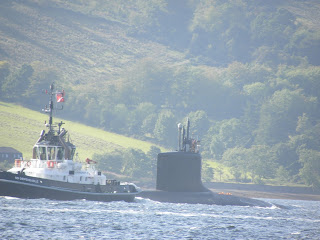
True further up the loch was a large nuclear submarine base but at this end it seemed fine. We motored toward the anchorage puzzled by the large tanker tied up to a commercial dock. Nothing odd in that as such but the ship was surrounded by boats on mooring buoys... We anchored in 10 metres between two mooring fields well content with our day.

The following day we moved up the loch a little and picked up the mooring buoy of good friends Mike and Eileen who we met years ago in the Canaries. Mike was away sailing in Iceland (where we'd hoped to meet up) but Eileen hailed us from the shore and we rowed ashore for a welcome shower and catch up. Over the next month or so we did something we have never done and that was to leave Hannah and head inland and go visit friends Robin and Jac. Partly because we obviously wanted to catch up but partly because the last Atlantic crossing had left me unsettled and with the distinct feeling that I had had enough and needed to do something else but not sure what. The time away would, hopefully, allow some peace and equilibrium into my confusion..... not sure that it did although it was good to do different things including driving 1500 miles but once back on the boat it is as though we had never been away. One thing had been decided though was that we needed to find somewhere for the winter and we checked out local yards to get hauled. A little cheaper than yards down south was an attraction but as day after day passed, far too often accompanied by rain, we began to think of moving south.

True further up the loch was a large nuclear submarine base but at this end it seemed fine. We motored toward the anchorage puzzled by the large tanker tied up to a commercial dock. Nothing odd in that as such but the ship was surrounded by boats on mooring buoys... We anchored in 10 metres between two mooring fields well content with our day.

The following day we moved up the loch a little and picked up the mooring buoy of good friends Mike and Eileen who we met years ago in the Canaries. Mike was away sailing in Iceland (where we'd hoped to meet up) but Eileen hailed us from the shore and we rowed ashore for a welcome shower and catch up. Over the next month or so we did something we have never done and that was to leave Hannah and head inland and go visit friends Robin and Jac. Partly because we obviously wanted to catch up but partly because the last Atlantic crossing had left me unsettled and with the distinct feeling that I had had enough and needed to do something else but not sure what. The time away would, hopefully, allow some peace and equilibrium into my confusion..... not sure that it did although it was good to do different things including driving 1500 miles but once back on the boat it is as though we had never been away. One thing had been decided though was that we needed to find somewhere for the winter and we checked out local yards to get hauled. A little cheaper than yards down south was an attraction but as day after day passed, far too often accompanied by rain, we began to think of moving south.
The wind remained consistently out of the south but a brief window presented itself... should we leave that night or the following day.... The forecast was for enough wind overnight but where we were anchored remained deathly quiet and our experience of the forecasts suggested they often bore little semblance to what is actually happening and so we trundled off the next day. In fog. With little or no wind. We persevered, happy that we'd spent the night in bed rather trying to drift, and now sailing along slowly but at least moving south despite the fierce tides that rush up and down the Irish Sea. We thought we'd do it in day trips but in the end just kept going albeit in some strange directions at times as we tried to work out tactics for possible wind shifts. As we slowly got south the forecast began confirming what we'd seen on Passage Weather - the northerly element would shift to the south or south west making the rounding of Cornwall difficult. On the morning of the 18 Sept, the supposed day for the wind shift, we were becalmed some 25 miles from Wolf Rock, which marks the end of Cornwall and the entrance to the English Channel. We motored. In fact we ended up motor-sailing all the way into the Helford as the winds were poor and the tides are fierce. At one point, as the tide was with us, I cut a corner and ended up in the rips of Lizard Point giving us a bumpy and unpleasant 20 minutes or so. I'll make sure I don't do that again.

We thought we'd have an easy couple of days getting to Plymouth but a phone call the next morning informed us we'd be hauled the following morning at 8 and we were on our way, motor-sailing again, up to Plymouth where we were hauled at 8 and where Hannah sits now. We were interested in seeing how the bottom looked as we'd been sat around for the best part of two months and how the two very different types of antifoul we'd applied 18 months previously (one to each side) had fared. No doubt that the better quality the better the protection.

For once the task didn't seem arduous and we rattled through the tasks, helped by the new sander and vac we bought. True the sander began to emit unhappy screeches after a week of sanding the hull. Bee never phased by misuse of equipment simply took it back and they gave her a new one whilst I skulked in the car. We ordered the Jotun paint and applied it
 |
| Hannah, nothing if not colourful |
Slight change of colour which meant we had to remove the dolphins we'd put on several years ago to piss off the purists. We also took the opportunity to get the gammon iron repaired as the eye that holds the bottlescrew from the inner forestay had worn a fair bit. 'course while it was off we had it galvanised too and I've now replaced the leather on the traveller as well so things are really moving along.
 |
| Traveller: about half way through the job.. |
In the course of getting a small job done I was directed down to another yard and wharf a few minutes from where we are. Two things came out of this: we'll be moving to this wharf when we launch in a few weeks, great shelter and a quirky feel.
 |
| Deep Blue Engineering windlass |
He is one of the few people I've met who instantly knew what an SL500 was and took me through a number of the points I had no idea of. I'm looking forward to getting to know him better over the winter months. Check out his site.
For the last couple of weeks we've been back in Berkshire, house sitting for Robin and Jac who are wandering around parts of Europe on their motorbike. The space of a house seems enormous and unnecessary after a boat....BUT the luxury of an oven, hot water and a bath are very enticing.
Millbrook, Cornwall
Wednesday, 3 August 2016
East and North and South and....
Dingwall and North
 |
| Dingwall Harbour |
With a favourable forecast we, sadly, left Dingwall early Sun June 16. Though initially we made reasonable progress although a tad hairy off the northern end of Cape Breton as the winds came down off the hills some 3 miles away and exceeded 40 knots. But on we romped, the wind was good, the temperatures cold as we headed for the Belle Isle Strait area. The second day, of course, the winds eased dramatically and we covered 40 miles in the 24 hour, noon to noon, period. As yet another forecasted 25 knots failed to appear we opted to motor the 12 miles back to St Barbe on the Nwfld coast. Soon after it came in and stupidly we bashed on rather than use it to get further north to Red Bay. The following day we made that journey and crept in around 6pm to be greeted by Mervyn, who has been greeting us for the last, who knows how many years. The community gets smaller, the school now has about 8 kids……
 |
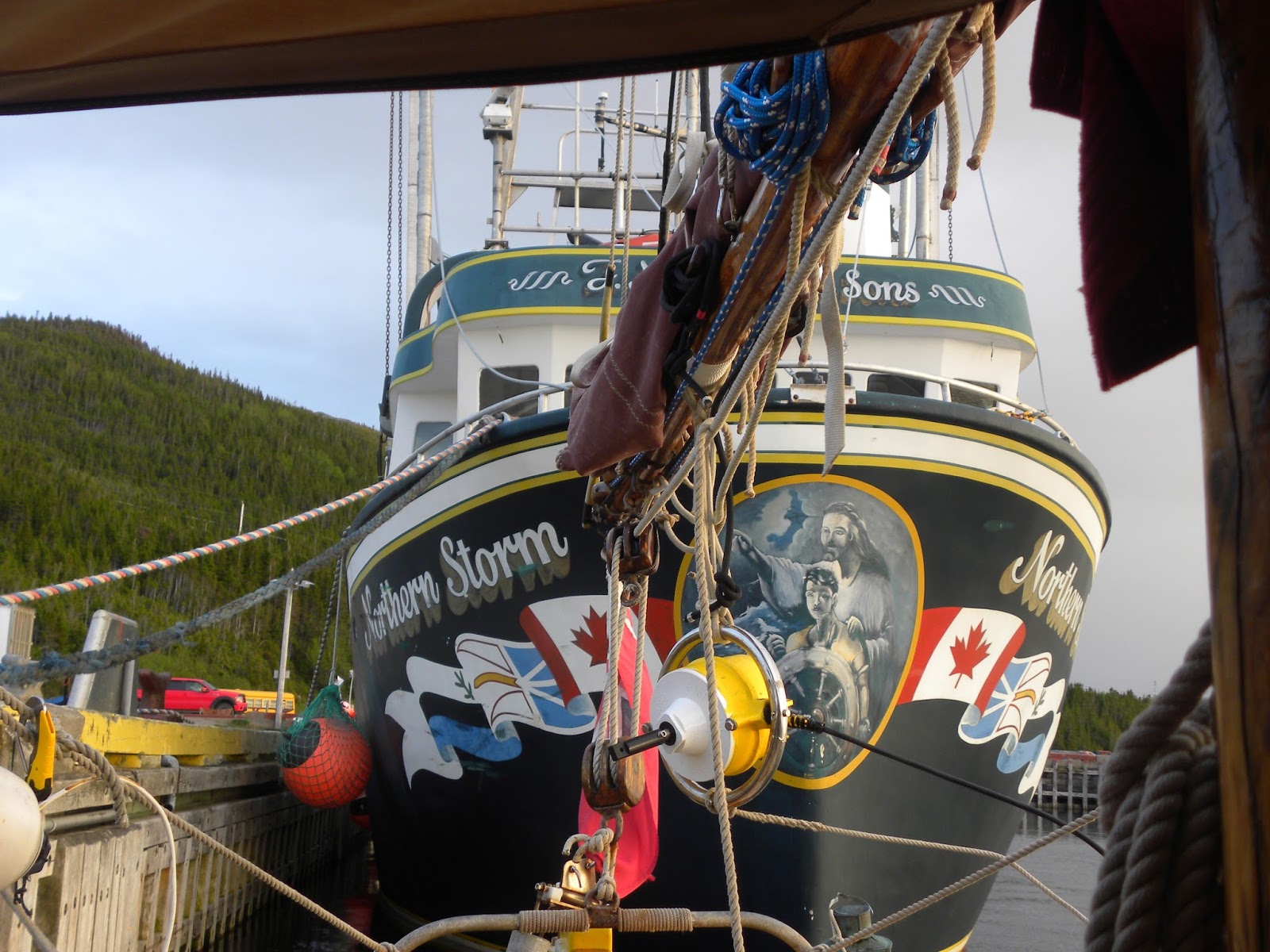
For the first time that we can remember we encountered ice inside the harbour - a ‘berg had grounded and broken up either side of the entrance channel. When we left, early the following morning, a large section had drifted across the channel to ground itself on the other side. Plenty of big ‘bergs outside, as there were last year. The day began bright and sunny, enough to lure us away from the dock, but rapidly went downhill with thick fog. The winds were still strong and though heavily reefed we were still moving quickly. Radar and eyes strained to detect stuff but nothing was”visible” although, having messed with the ground on the radar we were now only getting a 3 mile signal so stuff may well have been out there. As we found out when the sun made an appearance in the late afternoon. Huge ‘bergs seemed to be everywhere although the biggest surprise was the sight of another yacht heading in the same direction. Eventually Francis B hailed us, having recognised the boat, despite the sail colour change. They were bound for Fox Hbr, which we’d toyed with but thought the 3 day SW’s might be a great start. When the wind suddenly switched to the north then north east we gave up and motored to join them.
 |
| Fox Hbr- Labrador |
On again the following day, Sat 25 June. Little wind but we hoped to get clear of as much ice as possible in daylight…. A number of mistakes were made! The log shows poor speeds, until we’d been out 50 plus hours and we didn’t cover much. We also heard a vhf conversation between two ships where one warned the other to stay east of a position as the ice to the west was very hard. The position was close enough, I felt, to our route for me to keep to the east of our rhumb line. In the end it worked against us as the wind veered from NW to N and we were now heading toward the Cape Farewell area. True it was some days away but as the hours went by and we rattled along at a good rate I became increasingly concerned. Long time readers may recall the beating we took around this area when we returned in 2005, a beating that has remained etched into my mind. In the end this is just an excuse of course as the decision was made to abandon trying to head through the PCS (much to Bee’s utter despair) and head south of east to give Farewell a wide berth. The winds treated us kindly to begin with but a day’s run of 29 nm was recorded. Still, although slow, we were making progress toward Reykjavik a little over 600 miles away. The stiff NW’s kept us moving, albeit a little south of the rhumb but all was good. As ever, with us, we have trouble getting weather info…Bee had done a great job picking up stuff from Canada on the ssb but it was becoming less relevant as we had turned the southern tip and were out of their area. We had no success with Iceland or Greenland and I have never have been able to persuade weather fax to appear on the laptop. So we did what we always do, look at the barometer and read Alan Watts “Instant Weather Forecasting” However we did remember a snippet from the Canadians which indicated stiff easterlies(!!) coming on Tuesday. And they did. Initially we were able to make use of them and make some northing to get above 60N but as wind speeds hit between 30-40knots we surrendered and hove to, under reefed main for what we hoped would be a short time. As our course was taking us inextricably toward Scoresby Sound and the ever attendant ice we changed tack and drifted south. Not the worst sea conditions we’ve been in by a long way but the dreariness of the sky, a dull, dripping grey with poor visibility made worse by the patchy fog had a demoralising impact on us both. and our moods matched the bleak greyness. We remained hove to, checking the sky, childish hoping/imagining/wishing that we were seeing signs of improvement. And we did…blue sky sometimes briefly made itself known only to be snuffed out by the relentless grey ”wallpaper” we were covered by. We read up on what we could, deciding in the end that whatever it was had stalled and no change would be possible for some time. The wind, somewhere between E and NE favoured a southerly escape rather than a northerly one and so here we are; 3 days into a grey, sapping mire than shows little intention of easing. The winds remain resolutely out of the eastern quadrant, the direction we want to go of course, and whilst they eased from the 25-30+knots the seas remain lumpy. Our course wanders between SE and S, whereas our temporary destination lies firmly East. We’re hoping that we might soon, within the next 48 hours, pick up favourable westerlies and a little sunshine would be very welcome too.
Aboard, life continues although we’re both pretty fed up about things, weather wise. At the height of the blow when winds were consistently between 35 and 40 knots, the bitter end of the outhaul on the traveler came free and wrapped itself around the bobstay. This is the line that enables us to drag the jib to the end of the bowsprit from the safety of the deck so without it life was going to get harder. As the seas were still running hard we delayed tackling the job until things looked safer. It meant lying on the foredeck, armed with a boat hook and laboriously trying to persuade the line to reverse its tangling. Easier said of course as the waves seemed to recognise a bit of sport a periodically leapt onto the deck burying parts of me in water. The last part we left for a calmer day as it would require one of sliding out on the bowsprit to untangle the mess. Bee wanted to do that bit and today we duly suited up, roped her into a harness, attaching same to the jib halyard and away she went. She had discovered how to make the vids with our camera and I clung with one hand to the halyard, I filmed with the other. It took her about a minute to sort it out and we were both glad we’d allowed the seas to moderate and we’d done the thing first thing this morning as the seas are running again.
Mon 11 July
We continued heading SE for far too long, not that we had any choice in the matter as it wasn’t until 4am yesterday (Sunday) that the winds finally moved, reluctantly, into a westerly element. Finally we were able to make a more easterly course, albeit toward the SW tip of Ireland. With the change came a brightening of the weather, if not our mood, and blue pushed aside the awful grey that has dominated. Much, much worse than the last northerly crossing we did for sure. Toward the afternoon the winds backed a little more and we set a course for Barra in the Outer Hebrides, still a good 750nm away. When the winds eased yesterday we ran with more sail but reefed down again for the night. Hannah seems to run best with a quartering breeze under a double reefed main, stays’l and working jib, remaining, for the most part balanced allowing the steerer to cope. Speeds remain good, the last 5 days have all been above 100nm. As I write we’re bowling along at well over 6 knots….
The seas have been a frustrating combination. A long, loping swell usually out of the N or NE, battles with the normal wind-driven wave train meaning we sometimes get hit beam on by a great lumpy wave. Most are harmless but sometimes a larger version hits and we’re knocked over, lee deck under water and the sound of heavy spray and water tumbling across the windward deck.The swells are running at around 3m (10’) so are a real nuisance and we run at a less than optimum course in order to retain some comfort aboard but it remains a life at an angle. I’ve spoken of the “Air Only Vents” before but they really are a wonderful piece of engineering. Despite the lee rail being under, or when the bowsprit gets buried, either way we can get a torrent of water coursing across the deck in search of mischief, the vent lives up to it’s name. No matter what the conditions outside we’ve always been getting air in whereas when we fitted dories we’d remove the cowls and shut them off. If you still want to keep your dorades these little gems will fit inside giving you the best of both worlds. If you’re looking for a solution to ventilation try looking up this company.
Sat 16 July Under 200nm to Castlebay, Barra.
 |
| A rare moment on sunshine and flat seas... |
Thur 21 July.
 |
| Hebridean anchorage |
The journey ended with a whimper as we ran out of wind about 20 miles from Barra and the ebbing tide wanted us closer to the shore than we wanted so we motored to an anchorage. Thick fog accompanied us of course and the radar resolutely refused to produce a signal. We’d already opted to go for Vatersay rather than Castlebay as it would be less crowded. We crept in slowly although it’s a wide enough bay free or almost so of much danger. We checked we were where the chart was saying we were by testing actual depths against the chart, picking up the 10 metre contour and slowly made our way in. Dimly through the murk could be seen the shapes of boats and beyond the glow of lights from a small village. About 2am the anchor dropped into 10 metres, we dug ourselves in, went below lit the fire and poured a stiff drink and luxuriated in the notable lack of motion. Toots climbed onto the table, stretched out in front of the fire and went to sleep.
,
Thursday, 16 June 2016
Departures and engines......
As April morphed into May and last minute jobs were completed we began checking the weather for a window to cross the Gulf. A forecast for West 25 - 30 looked promising and the following few days would be helpful too and so a date was set. We rushed up to NE Harbour by car rather than sail to see Phil and Helen, met a last few interesting people on the dock and finally slipped our lines early one morning for Pulpit Hbr.
We've always tried to find a quiet place to head out from as it gives us time to get our heads together plus allows us a small shakedown to get us into the rhythm. This time with a stiff head wind we opted to motor much of the 20 miles to make sure all was well with the engine. And it was. Or at least until the last 4 miles when it cut out minutes after we had slipped through a narrow gap between a couple of rocky islands. As we had sail up we simply carried on sailing and once clear had a quick go at starting it. Of course it started but this was beginning to be more than frustrating. We sailed into Pulpit, with the engine ticking over until we needed it to back down on the anchor. It performed without a hitch. Hmmm.
 As we'd been ticking over for a while I revved it hard to clear the "tubes" and on the final rev it cut out. Ordinarily we would have abandoned the trip across, returned to Belfast and sorted the problem out but the weather window and the chance of getting delayed beyond our May 31st deadline decided us and the following morning we left Pulpit for Lunenburg. As we hadn't sailed anywhere for 5 months or so we reefed right down and then decided to use the trys'l anyway as with the 30 knots forecast we would still maintain good speeds without needing to worry about a preventer on the boom. In the event the wind speeds were more like 20 than 30 and within a few hours we'd changed to the main and soon removed a reef as the winds eased even more. The trip across was uneventful other than dodging lobster pots which continued until about 20 miles from the border between the US and Canada. As we crossed we began to get our towing generator ready to deploy but found ourselves coming across Canadian lobster pots and gave up on the task as a 50metre line with a small prop on the end is bound to become entangled and get wrecked.
 |
| Martha and Patsy's Traveling sweater |
We've always tried to find a quiet place to head out from as it gives us time to get our heads together plus allows us a small shakedown to get us into the rhythm. This time with a stiff head wind we opted to motor much of the 20 miles to make sure all was well with the engine. And it was. Or at least until the last 4 miles when it cut out minutes after we had slipped through a narrow gap between a couple of rocky islands. As we had sail up we simply carried on sailing and once clear had a quick go at starting it. Of course it started but this was beginning to be more than frustrating. We sailed into Pulpit, with the engine ticking over until we needed it to back down on the anchor. It performed without a hitch. Hmmm.

Cape Sable is always difficult to get right when coming from any distance away and this time had us arriving as the tide turned against us. We were far enough out, about 15 miles, to miss the worst of it but as it turns favourable earlier closer in it you can't stay too far off. Of course the wind died or at least became very light and we resorted to hand steering in an effort to squeeze more miles and make Lunenburg at a reasonable time. At one point with Hannah bowling along at 6 knots we seemed to be on target for an early morning arrival but it never lasts of course. By the time we got within 20 miles of our destination it was late afternoon and the wind finally gave up and our speed dropped to 0.7 k and we switched the engine on. Of course nothing happened. Before we got to work on it we called the Coast Guard to see if we could get the OK to anchor in a nearby bay rather than try to work our up to Lunenburg. After taking all the usual details the CG patched us through to the Customs and Immigration. They weren't too taken with the idea and asked us to notify them, via the CG, when we were anchored. Rather than mess with filters etc we just stuck a pipe into a jerry can leading it to the lift pump and dropped the return hose into the same can. Engine fired up, ran successfully and we started, slowly, for Lunenburg arriving about 11pm after Bee had done an amazing job spotting the local lobster pots in the dark. Even with our full keel we still get twichy about snagging these things so anyone with a fin keel and exposed prop must be having palpitations.

Still into Lunenburg we steamed, dark of course apart from all the town lights and we motored slowly up and down not quite believing that the town has not yet put out any jetty's for visitors to lie alongside. Not normally a problem for us as we anchor but the Customs guy's want us to tie up on the Government Wharf when they inspect us. Except that wharf is out of bounds as they're renovating...... after an hour we give up, not even the marina has a jetty out and we drop anchor, call the CG, get patched through to Customs and are told to ring again in the morning. We do, via Skype, and explain everything for the third time. We can see an empty wharf we can tie to but it will mean the Customs guy's climbing down a ladder to get to the boat. The voice on the telephone says fine, go there immediately as the officers are on their way. We motor over, get alongside and have some irate ticket seller for the charter boats come rushing over to say we can't tie up there. We do as we figure the Customs and Immigration trump a local misdemeanor. 10 minutes later they're with us. They look down 8 feet to where Hannah sits. "Can't we get the boat closer by removing the fenders" - we demur but offer to drag the stern closer by easing the bow. They agree and we comply but the number of ropes going everywhichway leaves them all a little uneasy. In fairness to them they were all pretty big guys bulked out with flak jackets and an assortment of matt black "weapons" dangling from their waists. In the end we were told to bring all our docs and come ashore and they'd interview us there. All civil and reasonably good natured and then we were free to go. A quick check around town, and then off to see John and Phyllis and get the engine sorted.

Still into Lunenburg we steamed, dark of course apart from all the town lights and we motored slowly up and down not quite believing that the town has not yet put out any jetty's for visitors to lie alongside. Not normally a problem for us as we anchor but the Customs guy's want us to tie up on the Government Wharf when they inspect us. Except that wharf is out of bounds as they're renovating...... after an hour we give up, not even the marina has a jetty out and we drop anchor, call the CG, get patched through to Customs and are told to ring again in the morning. We do, via Skype, and explain everything for the third time. We can see an empty wharf we can tie to but it will mean the Customs guy's climbing down a ladder to get to the boat. The voice on the telephone says fine, go there immediately as the officers are on their way. We motor over, get alongside and have some irate ticket seller for the charter boats come rushing over to say we can't tie up there. We do as we figure the Customs and Immigration trump a local misdemeanor. 10 minutes later they're with us. They look down 8 feet to where Hannah sits. "Can't we get the boat closer by removing the fenders" - we demur but offer to drag the stern closer by easing the bow. They agree and we comply but the number of ropes going everywhichway leaves them all a little uneasy. In fairness to them they were all pretty big guys bulked out with flak jackets and an assortment of matt black "weapons" dangling from their waists. In the end we were told to bring all our docs and come ashore and they'd interview us there. All civil and reasonably good natured and then we were free to go. A quick check around town, and then off to see John and Phyllis and get the engine sorted.
We began by removing the hoses that feed the filters from the tank. Although we used a pump to blast air through little came out but poking a wire through revealed a fair bit of crud. Part of the system is copper tubing and a closer look at this revealed it was going an unhealthy shade of pink and that was cut and removed. The worst part was in the ball valve which turns the fuel on and off. Bee discovered a large amount of crud in there and we decided to scrap the lot and replace. The hose, barbs and shut off valve were duly delivered and eventually the job was done. We had intended to install an old Racor filter we had but couldn't cleanly work it into the system and ended up installing it into the hand pump we use to fill the tank from the jerry cans. This enables us to fill the tank at sea without opening the fuel filler cap. The jugs are in a cockpit locker, the end of the hose is inserted, the bulb squeezed a few times and fuel flows into the tank. Now it has it's own filter (which has been lying around since our Taylor's Cooker days).
We went out to test everything, running the engine at 2000 revs and gradually increasing for long periods of time, even hitting 2800 (our maximum) and all without a murmur or complaint. Back on the buoy we did the oil change, changed an impeller and are ready to go. But the weather isn't. A brief period of SW, followed by a long period of head winds leave us unwilling to head off. We ponder, mull, look at charts, wonder how much we're gaining by moving up the coast to Cape Breton and, for the moment, think we'll head for Iceland from here saving ourselves a detour around the Grand Banks.
We "amuse" ourselves by helping out on Morgan's Cloud or painting over at Steve and Marilyn's. The work on MC is simply stripping and cleaning winches. The small ones, about the size of our largest, are easy and quick to work on. Not so the huge (to us) #65 which are complex and heavy. In total they have 13 winches but only two headsails whereas we have two winches and a possible 7 or 8 headsails.
We took a day off and went sailing, something we rarely do. Day sails I mean. Not much wind but pleasant enough as we sailed quietly amongst the islands north of here. A few lobster boats gathering in their traps as the season would end in a few days but essentially the waters were ours. We had to motor at one stage as the wind was blanketed by an island but once clear we had a great beat back toward the mooring. It may be our imagination but since we had the new sail the boat slips along much better in very light winds and for the first time ever we have found ourselves pointing closer to the wind. OK there were no waves to knock us about but we were 10-15 degrees closer than we have ever been before.


And finally. For years we have carried a small log on our foredeck. Casual visitors aboard; always comment on it, querying its purposeand inevitably guess it to be some sort of esoteric gaffer fender. We picked it up in Rockland Harbour in 2004 and it has remained in the same place ever since. Well here's the reason we carry it; nothing nautical.
For much of the time we spent at John
and Phyllis’s we were watching the weather, hoping we’d get
enough days to knock off some miles and make a dent in the journey.
As it became clear that more than two days of favourable winds for
the trip to Iceland were unlikely in the near future we began to
widen our thinking and find an alternative. Sometimes we (or really
me) get fixated on where we are bound and miss the obvious. Which in
this case was to break up the trip and, hopefully, go via the Prins
Christian Sund in southern Greenland. This will allow us to get up to
Fox Harbour in Labrador and then have a shortish 700 mile trip across
to Julianehaab, Greenland. So when the winds came in from the SW we took off
having said our farewells to two sets of good friends. Of course the
30 mile trip across to Halifax was slow as we rarely made above 4
knots but the following day was good and being 10 or so miles off
shore we avoided most of the lobster pots. As ever the forecast
didn’t quite live up to actuals and with the wind intending to
switch to the NW we began the last section up to the canal. It turned
into a beat and then a wet beat as the rain fell. With 4 miles to go
we switched the engine on motored in. The staff, as ever, were
friendly although we were initially mistaken for “Ironbark” which
we accepted as a compliment! At the other end of the canal Jack and
Glenda were waiting to greet us, refusing to believe our email that
had said we wouldn’t be coming through this year. An all too brief
stopover and the following day we were on our way again to anchor for
the night in Maskell’s Harbour, where it is possible to end up
completely landlocked in solitude. A wonderful stop.
 |
| Maskell's, soon after we anchored.. |
We left early the next day and motored
the 20 mile to the exit. The northern section of the Lakes isn’t as
picturesque as the southern bits but we were eventually out into the
ocean. The winds remained light but the promise was for very strong
easterlies overnight. With this in mind we continued to motor-sail
and arrived off the harbour entrance to Dingwall around 7pm in mist
and rain. It’s a narrow entrance, a little more than 100’ wide
with a bar. When a big easterly swell is running it would be
extremely dangerous but the seas were small, much less than a metre,
and we slid in between the welcoming breakwater overjoyed to have
made it before the rapidly building clouds astern of us arrived. The
anchorage is about 1/2 mile from the entrance, landlocked and
completely sheltered - scarcely a ripple on the water, a definite
hurricane hole. The following day no fishing boats left and we could
hear the surf pounding onto the shore and knew why. A friend had seen
us come in the night before and it was good to see him again after 6
years. We’ll lay here for a few days until wind changes to a better
angle and then push on.

A year ago we bought a second hand
Pudgy. In the last couple of weeks we have got around to sailing it.
The two of us can stretch out in reasonable comfort and, whilst it is
not the speediest dinghy I’ve ever sailed, it is a delight. Stable
enough yet it’ll still pick up speed with a small gust. Even better
from our viewpoint is that Toots has taken to it and will readily
come aboard to be ferried ashore for a roam around. We haven’t, as
yet, persuaded her that she should try the sailing rig.

Are they
expensive? On the face of it yes. BUT it does not require periodic
inspection, at huge expense, for an item (your life-raft) you hope never to use…..
You know when you dump it over the side to escape your home that it
will work because you’ve been using it regularly to row ashore or
pleasure sail around the anchorage which represents genuine value for
money. Anyway, it's our choice on the matter and we're very pleased.
 |
| Toots and her scratching post, lashings by Capt. Lance Meadows, Timberwind..... |
Dingwall
Cape Breton
Friday, 6 May 2016
FIRST WORLD PROBLEMS
Ordinarily we take the view not to be critical of the countries we're visiting, after all they didn't insist on us coming, but on this occasion we came to the conclusion that the incident merited a mention...
As the
temps began to warm a little and we came down to the last 15 days of
our visa we contacted the local Customs and Border Protection agency
in Bangor about extending our stay to give us a better chance of a
kinder weather window and to complete outstanding work....
the only way, we were told was to present ourselves at the nearest
border crossing and make the request. We hired a car, drove 125 miles
to the border and explained what we needed. The woman spent 90
minutes interrogating me about how we funded ourselves, how many
times we'd been in the US, when were we back in the UK and for how
long, were we legally married (?), did we ever work in the US etc.
All fairly regular questions although slightly odd as we were already
legally in the US and simply enquiring, and hoping to get, an
additional 5 weeks. In the end she said No we couldn't have any
further time and had we wanted to leave in May or June, rather than
April, we should have arrived in the US later in the year...... I kid
you not. Pointing out that a) crossing the Gulf of Maine in October
is cold enough, trying to cross in Nov or Dec could be dangerous and
b) we had, on two other occasions been granted in excess of 8 months
was met with a blank look. The best she could offer was that we go
back to Belfast, complete as much work as we could and then try again
just before our visa expired. Was I angry? For sure, having endured a
90 minute examination of my motives, honesty and financial integrity,
obviously been found wanting and then be told to try again in two
weeks struck me as ludicrous. What could possibly have changed? What
could happen over the next fortnight that would reverse the decision?
Well what happened is we wrote an extremely critical account of the
incident, slept on it, re-wrote it and sent it to the Port Director.
Nothing happened for a week and then we had an email asking us to
contact them. We would, we were assured, if we returned to the border
crossing be received favourably and the outcome would be different.
Good friends drove us up there. We parked up, walked, as instructed,
across the Canadian border and re-entered the USA. A CBP officer
greeted us by first name and we thought "Heh mebbe they have
been told to expect us..." The guy inside presented a blank
face, asked the same questions that were asked 10 days earlier,
queried the May 31 date we were asking for and behaved as though we
were just another set of, possibly, dangerous cretins trying to
damage the integrity of the USA.... Yeah right! How the hell does he
think the rest of the world views the nonsense that passes for the
Presidential nominations? I digress. Without warning the mood
switched, the guy addressed us by our first names, fingerprinted and photographed us (this is at least the sixth time we have been finger
printed/photographed -don't they keep records??) and then produced a
pair of pre-printed I94's, the slip of paper we needed to remain
legal until May 31. Pre-Printed! So all this shite questioning, all
this quizzing of how we funded ourselves etc was just this bored guy
jerking us around 'cos he could. How many brain cells does it take to
work out that these two people have 1) hired a car; 2) driven a 250
mile round trip; and 3) are asking for a 5 week extension all in an
effort to remain legal. Not one US citizen we spoke to, not one, thought we'd
done the right thing in bothering to ask in the first place....
Almost as annoying is being told by a number of these same citizens that if we
were Mexican we could pretend to speak no English and we'd be allowed
to stay. What nonsense! Particularly in a state where non-white
people are almost non existent so the experience of immigrants may
only be gleaned from Faux News or other rabid news stations. But someone needs to remember that for everyone visiting ANY country the Customs people create the first impression. Anyway
onto other things.
THE REAL SECRET BEHIND SUCCESSFUL "HIGH LAT" SAILING....
From
time to time folks ask us about the "north" and how cold it
is, thinking, perhaps, that the temps are always around freezing, the
sun never shines and you need rum coursing through your veins to stay
warm - I wish! What most people don't realise is that British boats
have an unfair advantage on the rest of the northern wanderers. The
UK may have been the last of the northern clime countries to
understand the "benefits" of central heating; I can vividly
remember, as a small child, leaving the only warm room in the house
where an open fire burned, and climbing stairs getting colder with
each step until finally reaching a bedroom on the top floor. If it
was 75F near the fire it must have been closer to 35F in the bedroom
but we knew the bed itself, or at least parts of it, would be warm.
The secret?
 |
| Our collection of HW bottles.. |
At the
end of last year we got in touch with Dayle Ward who with her husband
Tom run Traditional Rigging. Tom spliced up much or our rigging in
2004 and now we needed Dayle to make us a mains'l. Well the main is
here, bent on and looks great. But different. Although we could have
used Duradon as before it would need to have been imported and the
duty would have made it as expensive as the Oceanus cloth we opted for. We
looked at using tanbark but in the end went for cream. Walking into
the loft and seeing the sail stretched out we both thought "we
don't like the colour" but having lived with it for a few weeks
find it has actually grown on us. Dayle made some subtle changes to this sail compared to the last and we'll report back on how we've fared. Typically as we took delivery we
received a raft of emails from folks commenting on how they loved our
red sails.

We've made a few changes to the boat in the month we've had to get stuff ready. Some of it involved nothing more than a paint brush whereas others took a winter of mulling or arose out of a visit to Morgan's Cloud last year. For years we have put up with the inconvenience of the main blanketing the reefing cleats when we happened to be on the wrong tack. The cleats were on the starb'd side of the boom so a port tack reef inevitably meant fighting your way beneath a pile of wet main, particularly with the second reef, to get a clean pull at the pennant. Taking a lead from MC we've now installed cleats on both sides of the boom and the pennants, rather than ending in a thumb knot at the port side, are led back to the new cleat. Now we simply heave on the pennant on the windward side, making life a lot simpler. John and Phylis use winches but the principle remains the same and whilst their boat is much more high tech than ours it was the seamanship of the idea that grabbed us. One of the other changes we made was to use a modern line rather than 3 strand. For the most part we use 3 strand everywhere but using different colours enables a far quicker identification when vision is restricted and with the combs well greased with tallow they should slip through particularly well. We've done the same for the mizzen too. Incidentally if you're not aware of their site Attainable Adventure Cruising it is well worth, as I've said before, having a look.
Some of the amazing shots Russ took last year.....


Subscribe to:
Posts (Atom)