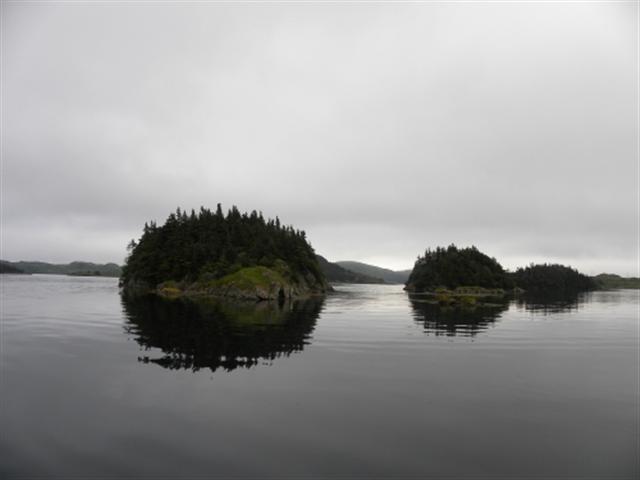
Tuesday, 21 September 2010

A summer in Labrador

Anse de Portage, Quebec coast
Wed 30 June
So here we are, at anchor on the southern Quebec shore in a small bay called Anse de Portage. To the east of us Blackthorn rides to her anchor and they periodically call us to report wind strengths. 42knots in the gusts but generally around 30 and tho we have a bit of wave action we're all comfortable and safe. We left Cape Breton about a week ago and worked our way up the west of Newfoundland and crossed over a few days back. The crossing, an overnighter, rewarded us with a cold night but the day brought whales galore and ice-bergs drifting with the current or more probably aground. Unfortunately too far away to photograph but no doubt that'll change in the next month as we get further north. Yesterday we tramped across the hills that surround the anchorage to check out at sea for whales (non) and ice-bergs(one). No trees of course but lots of rock, fresh water pools to drink from and tiny flowers abound. The few cabins that are around belong to families from St Augustin who use them in the summer as fishing camps. When fishing was the major (only!) source of income for local people, summer would arrive, the ice disappear and entire families would leave their homes on the mainland, coming to live at these outposts to spend the summer jigging for fish. Whilst these places are still in use, the fishing is mostly illegal as quotas are small. Last winter had been so mild that the folks were unable to drag the wood across the frozen bay by skidoo and have to bring it to the cabins by boat. Our fire is running happily, thanks to a shed load of wood from Cary and Kevin, a kettle boiling gently and Toots has managed to raise herself from the prone position in front of the heat to feed from her bowl....but only because Bee is holding it at the correct angle and she can eat without too much effort! By the way the temperatures are a balmy 46F. And that’s during the day when the sun is out and no wind is blowing. Virginia it ain't as we hear the east coast of the US is wilting under 100 degree heat. This part of the coast has a Hebridean feel to it, bare rock, few, if any trees, very sparsely populated probably less rain here than the Outer Hebs. But generally the pack ice is pretty solid until May so a hard environment to live in. We were talking, the other day, with a guy, Kelly, who was originally from here . (He'd come by the boat to give us a salmon that was about 18" long!!) He began life as a fisherman, became a teacher but 5 years ago gave up and moved to Quebec and now works for an Insurance Company. He returns each year with his family (his wife is from the next community up the coast) to fish, look for ice-bergs and reconnect himself. The kids miss the city, think it’s too cold here and nothing to do!!. No road to connect to the rest of Canada just a rapidly disappearing way of life. Until about 30 years ago the Hudson Bay Trading Company still maintained a trading post where the locals could bring in pelts to trade for goods but no more of course. When you read about the history of these places, those further north in Labrador and much of the Newfie coast it brings it home how rapidly life has changed in the last 100 years but more especially for these communities in the last 50 or less. The skidoo changed things immeasurably when it began to replace the dog teams. Easier to handle than dogs and without the tendency to attack young children, skidoos enabled a much greater social life allowing visits to family on a more regular basis I guess. Kelly's father ran a team and hated his dogs and all the trouble associated with them. The little we've seen of the Quebec coast has had us planning a future trip to this shore but approaching it via the Northumberland Strait and starting much further west..will we ever get out of the North Atlantic?
Dolphins, |Belle Isle Strait


Since I wrote those lines we have moved on and are currently awaiting a fair wind to take us up to the east coast of Labrador. We're at anchor in Red Bay having arrived a couple of days ago with R&J. And then soon after by a 60' boat from Maine heading for Greenland. Red Bay is famous for the sunken ships found in the bay - this area was a huge Basque whale processing area back in the late 1500's and a lot of artefact's have been uncovered. Along the shore is a coastal steamer that broke loose in a northerly storm and ran aground off an island. The hull is slowly rusting away having been there for 40 odd years. Outside the harbour an iceberg is visible (or would be if the fog lifted...) aground and further out we passed one, also aground, that broke up with an enormous bang. Luckily it was at least a mile away. Whales are everywhere, often very close into shore as the capelin have arrived in huge numbers and humans and whales are in competition to see who gets the biggest share. Apparently capelin, some sort of small fish, only appears for a limited time each year so the activity is frenetic. All this talk of ice-bergs and pack ice would make you imagine we're in the Arctic Circle but we're about the same line of latitude (51.43.7N) as Maldon

The previous port of call was Lance A Loup where we tied alongside for the princely sum of Can$1 a night which included the shower. Locals wandered down to the quay to chat or wave as they headed out to catch capelin. By the standards of what we saw last year (and so far this year) this is a fair sized and prosperous town with a thriving fish plant. Hopefully it'll continue.

On our previous trips across from Cape Breton we've used Ingonish as a springing off point but thanks to info from various people we used Dingwall and found ourselves a great place. We were worried about the depths going in but had been assured that by sticking to the centre of the channel we'd have no problem with our 7' (2.10 metres) depth. We're often led to believe that the depths are fine for us but we've learnt that it pays to ask what size boat the person supplying the info runs.... but in this case Hammy (our informant) had brought deep draught vessels in and large fishing boats still went in and out so although we entered slowly it all went smoothly and we tied up to a fishing boat for a couple of nights.
Thurs 8 July, Finally it seems the wind is about to move out of the east and round to the SW giving us a free run up the coast. Well the weather reports have promised us that before and not delivered so we'll see how true this one turns out to be. The sun is trying to burn the fog off, breakfast is over, the bread is baking and we're ready to go...

July 14 Penny Harbour 53 08.81N 055 46.47W So much has happened and with no chance of posting this page for some time I'm resorting to periodic updates as we move north. In Red Bay R&J headed back to Newfoundland to get a medical issue sorted after much soul searching. It was a subdued pair of boats that parted company that morning as we, separately, headed out into thick fog and little wind. Our course was taking us north and we pottered on through the fog, visibility reduced to a few hundred feet. Unlike the previous fog trips we now had the "comfort" of a radar we'd fitted a few months ago and it proved its worth as we were able to "see" something on the screen that wasn't on the chart and out of the fog loomed a large berg.... 
Cape St Charles, Labrador


Onwards we motored and finally approached Cape St Charles and our anchorage for the night. Still the fog persisted and we crept in as the wind began to pick up and found the deserted wharf still in usable condition and tied up for the night. Toots was ashore before we'd even got a line on and that was pretty much the last we saw of her as she roamed her new home.

Part of the joy of these trips is in reading the pilot books to pick out spots we think we'll like. Sometimes we're disappointed, sometimes overjoyed. So our next destination, Eagle Cove and Squasho Run were, we felt, over rated and hadn't lived up to the anticipation. Squasho, a narrow 3 mile run between rolling hills was OK rather than exceptional but was made interesting by the COMPLETELY wrong directions on the buoys in the channel....but the anchorage for the night and where we are at the moment is simply wonderful. 
Penny Harbour


Cabins dot the shore, though few are used any longer and last night as Bee was stood on the companionway steps she almost screamed her delight when she spotted a black bear ambling along the shore toward some of the more remote cabins!! We spent an entertaining hour or two watching it grub amongst the grass, stand on its back legs to scratch its back on a convenient cabin wall and occasionally peer in our general direction.

I might add that we were watching all this from the safety of the steps. Not because of the bear but simply because the amount of Black Fly and mosquitoes are unreal and we have a purple net stretched across the entrance. A green one over the skylight and a white one across the fore hatch! The bugs are a serious threat to your sanity as light winds mean they're everywhere - coming through Squasho yesterday they were joined by, what looked like large, evil looking horse flies but may have been a hornets of some kind. Soon after the bear wandered off and a fishing boat came into the harbour and unloaded gear. One of the guys came over to chat explaining he was the only one now who used his cabin, giving a quick rundown on remaining cabins, relationship of owners to him etc. before heading back in to get his cabin sorted out. The bear came back soon after but not for long and no sign of it this morning.
5 years ago today(July 14) we left Labrador for Greenland. How different things are for us this time around. Better prepared, able to get weather forecasts and with protection from the wind and sea I wonder how we would fare this time? I doubt the fear element would be any less somehow.
Slick from a crash dived whale...

This last winter has been a mild one for the folks around here and for us it seems we get to see a lot of icebergs, mostly aground as we make our way up this coast. Lot of growlers and smaller lumps about as well but the winds have been light enough for us to easily spot them and so far we have resisted the urge to get too close unlike the whales who seem to delight in surfacing alongside us or more disconcertingly immediately in front of the bow.
Sometimes we just swerve out of the way but one was so close we had no time to react and watched as it crash dived a matter of yards away and we sailed over its slick. Whales are everywhere and you can see, dotted around, their distinctive plume of spray as the surface to breathe. Mostly in pairs but sometimes in groups: we never tire of seeing them around us.

Wed July 20 Rogers Harbour 55N 58W Ever further north we move although we have had one day of sailing and a lot of motoring. The sailing day saw us on our way from Packs Harbour to Emily Harbour with big seas and speeds between 7 and 8 knots. A deep low south of Greenland was the culprit and whilst it helped us move rapidly to a good harbour it proved to be a stressful day. Not content with big swells we were also moving through an area that had numerous rocks and shoal areas that are off shore.

The breakers are fairly clear but as we passed by we'd wonder to each other how many boats had come across them, too late, in thick fog. As they say in the Pilot book - all yotties use out of date charts on the grounds that the rocks don't move. Up here they ain't found all the rocks yet.. By the time we arrived at the anchorage we were pretty tired from the combination of fog, icebergs, growlers and rocks....it’s good job we do this for pleasure 'cos the money is crap! We stayed at anchor the following day and were rewarded with a second sighting of a Black bear roaming the nearby hills.

Yesterday was spent under power with the help of our secret weapon - a spinnaker we fly when all else fails...actually this was the first time we'd flown it and though it certainly helped it ain't a sail we'd leave up overnight or at the slightest hint of an increase. Luckily we'd dumped it as we approached Cape Harrison and the main was well reefed down to stop us rolling...the wind began to increase as we neared the Cape and by the time we'd rounded it, the wind, had doubled or trebled in strength and we were faced with icebergs blocking the entry to the bay we were due to anchor in. Thankfully the second entrance was free of such beasts and we struggled through under motor, working our way across the bay to anchor. The wind continued (caused by the downdrafts from the high cliffs that front the southern side of this bay) and we crept close into the shore before dropping anchor. As the Rocna anchor bit, dug in and held us yet again without fuss or failure (we would previously have come into an anchorage like this hoping desperately that the CQR would hold) we were thankful we'd shelled out the cash for such an important item. As Bee said yesterday, as we worked our way through growlers and fog, "this is like some kind of video game - last year we were in Newfie and this year it seems we've gone up to the next level of difficulty..."

Whilst the ice continues the whales do not and we haven't seen one for several days now.

Friday 23 July...Hah! Yesterday we woke up and in one of those bizarre connections thoughts: the amount of motoring we faced and the possibility that we'd have to motor back as well. Listening to the forecasts for northern Labrador have shown us that the winds there are lighter than we've experienced so far. Anyway to cut it down to a sentence or so we decided that the prospect of 600 miles of engine work wasn't what we'd joined up for so decided we'd turn around!! As I write these lines the wind is still very light and whilst Hannah is a wonderful sea boat her weight means we rarely get above 4.5 knots under power and more often around 3 or less. To seaward of us lie a ragged line of BIG icebergs, aground in deep water. The last couple of days have seen 30 or so icebergs around us (luckily not too close) including a couple with seals sunbathing(!)...the temperature is about 10-12C so it ain't that warm although the seals probably have a different perspective. We're spending a couple of days pottering between some cracking anchorages awaiting the passing of a strong SE'ly and hope to use the equally strong NW'ly to get across this next section which has few suitable anchorages. Last night we anchored after a long day having passed a solitary tug and tow heading north. He couldn't resist calling us up to ask what the story was. Turns out his trip will end in Hebron and then they pick up another tow to the Arctic Circle...he gets home in mid-September.


Today we moved slowly through the islands to an abandoned processing station. It's a great setting and the government wharf built in 1990 is still usable. Toots is ashore, of course, and to our surprise another boat came in a few hours ago, From Makkovik. it's heading toward Lake Melville to pick up some research workers for a month of studying puffins etc. Randy, the owner, is Inuit and staggered us by casually informing us that he just loves "Are You Being Served" the sitcom from BBC TV of the 70's or something....talk about culture clash - at least in our minds. Bee also persuaded him to try Marmite.."I prefer seal meat" he muttered after a tentative taste.

This is a remarkable place. For the most part the islands/mainland we've seen so far are fairly low lying mebbe less than 300' although we were just reaching the area where the Benedict Mountains offer themselves as a backdrop when we turned south. The islands are barren although the ones in this area have moss or lichen growing on them but here trees are a rarity. There are few communities now that are inhabited - Cartwright; Makkovik; Hopedale; Nain are the major ones

July 31. Anchored in the shelter of Hawke Harbour, an abandoned whaling station. Astern of us lie a couple of rusting hulks, small whale catchers.
Behind the point lies the station; like the ships rusting away. It looks to be a bigger site than the one we saw last year (Fourchou) and, perhaps because of its setting amongst green, wooded slopes, less foreboding than it too.

We've had a couple of cracking days sailing, found some great stopovers, "met" another yacht and had tea with a couple in Bateau Harbour. A small, well sheltered bay with a few cabins occupied for the summer. Jim and Shirley come back every year (she was born there although her home has long since fallen down) Jim hailed us from the shore as we turned Hannah to get ready to anchor, urging us to use the tiny jetty and stood by to take our lines. Great place with friendly folks. Luckily Jim had a chart that covered the "missing" few miles between our charts and we were able to make a rough copy with waypoints to take us through the various tickles and save us heading further out to sea. We pottered south using a combination of main and engine, poked our nose into Square Harbour before heading further south to Occasional Harbour. The entrance had several 'bergs aground and numerous growlers drifting around in the swell. This is the place we'd left from 5 years ago (though no ice at all that year) and our memories were of a long search to locate shallow enough water to anchor in. Better informed this time we worked our way behind a small island with a minimum of 10' of water (3' under the keel) and anchored in a well sheltered spot for a day or so. Wonderful place as trees line the hills and the sun shone brightly and warmly. Think the temperature must have got above 20C!!

Today (Aug 2) we've moved a few miles further south and fetched up against the inevitable abandoned government wharf in Ship Harbour.

Built about 20 years ago these wharves were the life-blood of many communities but with the death of the cod industry most were simply abandoned. Now they make handy calling points for yachts heading up and down the coast. Toots, of course, loves them and heads off as soon as the first line hits the shore. Rocks are her favourite... As often happens when you least expect it you stumble across a cracking stopover and this proved to be. Quite stole our hearts with its evidence of bear pooh and a noisy chipmunk!

August 10. We've been holed up for a few days, firstly in Fox Harbour and then for the last two days in Henley Harbour. A natural harbour, Henley has been in use for the last 500 years or so. The Basque's used this harbour extensively and then perhaps a 150 years ago the Stone Family arrived from Dorset. Many of their ancestors still have cabins here but no one has lived here permanently since the '70's when the government withdrew teachers, ministers and other necessary people for the community to flourish. I say permanently but, in fact like all the families along this coast, families would live here in the summer and then move to nearby a winter home, in this case Pitts Harbour.
Notwithstanding the government decision the families returned each summer to fish until the cod industry collapsed and each year the fishing restrictions increased as the amount of fish dwindled. We met several families, all related, who were actively rebuilding the cabins. 10 people were on the two islands, fishing, bake-apple hunting and trying to avoid being chewed alive by voracious black fly before returning to various communities around Canada. Up and down this coast there is evidence of these abandoned communities as there are in Newfoundland and the southern Quebec coast. Sometimes we're lucky enough to be at anchor when these folks return for the summer and are able to learn a bit about their history. This area has a striking resemblance to the Outer Hebrides and yesterday we watched the fog roll in, clear, the sun come out and disappear all from the safety of the companionway as a stiff SW bowled through.

Friday Aug 13. St Anthony's harbour. Tied up alongside Blackthorn having had a 50 mile sail down from Henley a day or so ago. The day started well at 5am when Toots returned from her nights wanderings with a live mouse......she let it go in the saloon and we spent a frantic few minutes trying to recapture it so allow it to return (unharmed) to its proper habitat. As we were up we decided we'd head out early and had a blissful 4 hours crossing the Belle Isle Strait with hardly any sea, 15 knots of wind and a very comfortable 6 to 7 knots. We opted to go round Cape Bauld rather than Quirpon but found little enough breeze and a lumpy sea pushing us into using the engine to cover the last miles to the harbour. Blackthorn was easily spotted amongst all the fishing boats and we managed to tie up before R&J got back from their wanderings. As "Happy Hour" was approaching we knew they wouldn't be too long and sure enough along the quay they came. The last they'd heard we were heading along the Quebec coast so it was a bit of a shock for them. With Robin's recovery going to plan they hope to leave here early next week, helped by our man Ham from Dingwall. So we've filled the fuel and water tanks, and entertained the local fishermen who, for some reason, cannot believe a man with a beard, dreadlocks and pink Crocs has appeared amongst them...obviously led sheltered lives.

18 August St Barbe Another few days pass as we wander the Newfoundland coast. We left St A and R&J and headed off to have a look a Hare Bay, an area we'd missed last time around. We had wanted to look at 2 spots in particular and managed to spend a night in each. Both were OK but not what our minds had built them up to being much larger than we'd imagined. The pilot guide suggested Maiden's Arm to be a haven of wildlife but we saw only gulls and Goose Cove was a small fishing harbour. Back up the coast we went, spending a night alongside the wharf in Quirpon and then pushing on along the northern coast. We opted for a small community called Raleigh and found a real gem! Sailing into the natural harbour we dropped the main and began motoring across to anchor. A small boat came out from the shore warned us about a shoal area and suggested we use the wharf. At that moment Jackie rang us on the vhf to let us know they were on their way from St. Anthony and changed their plans to head into this place too. Friendly folks, the town bathed in bright sunshine and, it seemed to us, an air of prosperity about it. Talking to local people produced a familiar litany...few families, kids moving away as soon they're able, schools closing and the fishing industry almost dead. The fishing industry is in trouble everywhere we've been as quotas are cut and fewer people are able to earn a living. The quota system seems pretty dumb as the nets etc seem indiscriminate in what they catch and once the net is up and the catch sorted anything that is "illegal" is thrown back but by then it is often dead anyway. The opinions as to why the industry is like this vary enormously. Many feel the rush of mechanisation; ice and processing ships accelerated it..... Draggers destroy the sea bed....and many older fishermen say that seals have destroyed fish stock.....Who really knows but we watched a number of boats come into St A's to unload shrimp and crab and talking to the guys they told us they were unloading 65,000 tons of shrimp from each boat. I know nothing about shrimp, their life span or breeding habits but that seems a lot of fish. How long can that last?

Both boats left the following day and spent a mind-numbing 10 or so hours motoring down the coast. Flat calm for most of it with a brief hour of wind we eventually pulled into Flowers Cove for the night. Big, well sheltered dock with a welcoming committee. Towns regularly have "Home from Away" weeks when ex-residents come back to see everyone and have a good time. This one had started last Sunday and we were welcomed with alcoholic gusto, urged to attend the dance and the festivities that would continue for several days more. Needless to say both boats opted out and slunk off to bed. Although many Newfoundlanders have English ancestry they must have got their partying habits from the Basques as the dance didn't start until 00.30 and continued until 4am.....Blackthorn left early to continue on down the west coast whilst we dawdled before heading out. Opting to motor a few miles down the coast to await a bunch of easterly days heading our way we got caught in a huge thunderstorm and downpour that, thankfully, only lasted an hour and we were soon anchored up in a river behind the ferry terminal.


Aug 27th: Alongside a floating dock gathering our breath after a crappy day in the office getting to Kegashka. But what a week or so we've had! We crossed from Newfoundland back to Labrador and tied up to a fishing wharf in the harbour. The forecast was for calm with easterly wind the following pm. As we were very exposed to the east we went to bed hoping the forecast would be accurate. But at midnight the easterly wind began and Hannah began bumping and creaking, chafing against the lines. Sleep was no longer a possibility and we fled before it got any worse, cruised through the night and made a longish passage to get to the Petite Rigolet area. An aside. Looking at the names of these places and their obvious French origin we've pondered for some months how to pronounce them..Rigolet might be "Reecholay" or "Reegolay" we thought. So we asked and found the local pronunciation is more "Rigullet" with no French influence whatsoever. That night we anchored in a deserted bay to the sound of loons after an interesting sail, in gathering winds, through narrow channels aided by a wonderful set of leading lights or marks. Up the next day with an easterly still blowing we cruised down to the Rigolet under staysail alone and entered this absolutely brilliant 19 mile passage with little wave action but a following breeze. The hills aren't steep but rounded, grass covered and interesting to look at. From time to time we see a small house and passed, some distance away, the community of St Augustin and began checking out several bays before we reached the exit. Found a gem, anchored in 20' and listened to the lonely. evocative cry of another loon as we opened the home-brew for the evening ritual. Then on again, still under stays'l to Passage Germaine.

This narrow, perhaps 50' or 15 metres, gap in the rocks guards its eastern side with numerous rocks and shoals forcing the boat to run parallel to and close to the rocks. The chart indicates the depths to be around 5 metres but we went through, under sail with 8 metres of water and out into the bay. Crossing the bay we decided to head for Anse de la Portage, a narrow cut that would give us some shelter from the easterly then blowing. A few miles from the entrance the new forecast warned of a switch to the NE, the way the cut faces yet we pushed on! Needless to say it was useless, the wave action was reduced but even the easterly wind funnelled down it and the depths were excessive so out we go. By now options were reduced but Bee's reasoning prevailed and we pushed around Mecantina ("Macatna") and northwards to yet another great spot featuring rocky, intricate passages although mostly exposed as we're close to low water. Light was fading as we worked our way in, anchored to a repeat of the Loon from the previous few nights. The following day we motored out, checked a couple of nearby anchorages before setting sail for a slow beat in sunshine, blue skies and a light breeze for Harrington. While still some miles off we watched a bright yellow plane take off and then head low across the water for us. Then back around us before he headed north. A hour or so later he came back, buzzed us and then flew on toward the coast. Tied up alongside in Harrington the pilot later came down to talk to us - the plane is an Ultralight and he'd taken photos of us as we did of him...

Harrington is a jewel. A small, thriving community of about 300, their multi coloured houses are clustered around the harbour. A wooden walkway serves as a road, the vehicle of choice is the Quad bike and the views from the hill top are stunning. We walked the town, marvelled at the wooden roads and, like so many other visitors I'm sure, thought..."we could live here" We'd met a couple in Baddeck, Chris and Annie Law, who had lived and cruised this area for a number of years. A keen eyed resident had seen us rounding Mecatina the previous day and mistaken us for them or rather the boats and telephoned the news around. Sadly for all concerned it wasn't the Laws but at least we were able to pass various messages back and forth.

With a few days of easterlies coming we needed to position ourselves closer to the Cape and so left in a SW wind for a beat to the next available anchorage. The winds are normally light from early morning until 10am then build until late afternoon before easing in the evening. The 14 mile distance took 36 miles to achieve as we fought both wind and current to reach it. What looked to be a soso anchorage turned out to be good and with the promise of strong easterlies arriving overnight we opted for short sleeps to enable us to leave at the first opportunity. It never came. The winds were late but we left anyway at first light using the motor to help get round Cape Whittle were the angle would free us up for the wind. The seas began to build but the much trumpeted wind never really did and we ran before a lumpy, quartering sea using the engine to keep up speeds. It was not our finest day as we pondered about whether to stop or continue to hope that the wind might increase (but only so far) and we might make a destination before dark. Well we kept on for Kegashka, the chosen point of departure for the southern leg. The coast we're now on is shoal and rock strewn. In a SE wind it is also a lee shore with all that implies. The harbour we were heading for has a narrow, SE facing entrance but I felt confident we could get in and find shelter without too much hardship.... In a lull and just off the entrance Bee nipped forward and dropped the main, despite the fact that the wind was astern of us and just that would normally make it a sod of a job. Not this time but as we were getting it stowed I saw a flash of white to port and realised just how shoal things were off the entrance as the sea was breaking with some fury over the rocks and a rock strewn shoal to starboard. So no straying off the line here then! Inside we dumped the stays'l and tried to work out the layout of the place. A yacht and a coastguard boat were bouncing around on the jetty, the sea spray was breaking over the wall so we sensibly chose to anchor and sort ourselves out the following day. This morning a RIB approached to warn us the barges we were anchored would be moving soon and were we aware that we were a boat length off the shoal area...

Sept 03 2010. Big Harbour Bras D'Or Lake....and we live to tell the tail. We spent a few days in Kegashka in the company of another guy from England who was taking his boat north over the next year or so, tracing the journey of an Inuit captain in 1811 (www.dennisonberwick.info) before we headed in separate directions. We headed south on a long beat to try to get a good angle for the next wind change..hah!! The idea was that we worked our way to the Magdalen Islands and then through Canso Lock. The wind died, picked up but never stayed. The weather forecast began to warn of Hurricane Earl approaching as we slowly, so slowly moved south. With 110 miles still to go to the lock we decided it made more sense to head east and over the top of, nearby, Cape Breton and into the Bras D'Or allowing us to quickly seek shelter should we need to. No wind had us motoring the distance and we went through the Narrows in the dark with the tide running almost 3 knots against us. But we were in and now we had options. 13 mile from the entrance afforded us the first chance of good shelter and we pulled into Big Harbour, slightly taken aback at the sight of a new dock with large yacht on it and another smaller one at anchor. Plus two smaller local lying to moorings. A stiff drink and bed after a 311 mile, 87 hour trip. In the morning I woke from a dream of being anchored in some remote part of Labrador to the sound of an engine. Peering out of the companionway showed no boat but I couldn't believe the green, wooded hills and houses of civilisation!! Later that morning a couple, George and Lillian, came over to move their boat to a more sheltered part of the bay and came aboard to chat. In the course of the conversation they confirmed that a yellow boat had been anchored here but had left some time back. So close!! The yellow boat is, of course, Pete and Lucia and they were hoping to meet us in Newfoundland someplace so our paths had crossed but not coincided and we were unlikely to see them now for years. As George and Lillian were heading into Surprise Cove and claimed the water was deep enough for Hannah I accepted the offer a ride, took along our lead and line and sounded our way along the channel. Sure enough we found 3 metres, except for one tight area, all the way through . The pilot book they were using was from the 70's and as we came to the end of the "known" bay as far as our charts were concerned a narrow, perhaps 10 metres wide channel opened up. Trees overhung the edges and roots were visible at the water’s edge but they were confident we could get in and as a hurricane hole, they said, it would offer complete shelter. As we rounded the final corner I was staggered to see, serenely at anchor the familiar shape and colours of Fair Grace at anchor!! I ducked out of sight below decks and we motored up to them; Lillian asking a bemused Pete various questions supplied by me before I popped up like some kind of out of control Punch and Judy show ending Pete's increasing belief that Care in the Community had been taken too far. Much catching up to do of course and in between we managed to get back to Hannah and with Pete standing on the bowsprit we edged our way into a very sheltered spot. Rafted alongside, we strung out 4 lines from the 2 boats to hold us in place and we'll see what Earl brings.

Wed 8 Sept. Well Earl brought very little for us, except leaves on the deck but a lot of strife for many others. The tree tops moved but the water remained placid as the cliffs and woods surrounding the shelter we were in proved to be a winner, True we had to rescue a lobster boat that wandered off but that was down to poor anchoring rather than weather. In the two days before Earl arrived we even managed to go swimming as temperatures reached 30C and the cool water beckoned. George and Lillian came by, entertained us with stories about life in South Carolina, raccoons, alligators and such like and extracted a promise to call in on them on our way south. The two Brit boats left the anchorage together although P&L were heading for Baddeck and Internet facility whereas we wanted to push on a bit. In the event we spent most of the day beating against a stiff headwind and tide combination. And then to rub it in we found the quiet anchorage already had 4 other boats at anchor - almost as many as we'd seen the entire summer! But we moved on the following morning, leaving a startled P&L to their own devices as we wanted to be moving and they are still trying to decide what to do about the winter. We got down to the canal about 4pm, tied up and relaxed. In the end we spent a couple of days there, renewed friendships and went through the lock to have a look at Isle Madame. Through the Lennox Passage and its narrow Bascule Bridge that opens on demand and then south to get ready for the long haul to Shelburne. The long term forecast had spoken of 3 days of medium strength winds from the north but come the day it proved to be 36 hours of northerlies, very strong in the area we currently were. We left early, managed to keep ahead of the worst of it and had an exhilarating 24 hours or so. As ever, it seems, as the front passed through the light winds followed, the speeds declined and with 15 miles to go we opted to motor the remaining distance to one of our favourite towns.


Friday, 21 May 2010

Portsmouth to Belfast

  
Well what can we say’? Nearly 6 months since we last wrote and I’m not sure what the hell we’ve been doing in all that time... Certainly we worked on Hannah far more than we had originally intended and did some work on other boats to keep our hand in but the time just slipped away and before we knew it we reached our departure time plus and slipped our moorings in early May. So here’s a quick run through on what’s happened.

Hannah. A colour change as we found the cream latex paint we’d used on the coach roof, whilst durable, turned black from the soot from the chimney and we could never get it clean. Our great friend Cary had supplied us with some paint he’d had left over from a job and we used that to tidy up the boat. Plus we decided to try the Cetol teak stain and have been more than happy with the result. All this took several weeks/months, as we needed to work between weather systems. In fact at one point we nearly didn’t work at all as, standing on a float alongside Hannah, I dropped an electric hand-sander into the water. I could see it buzzing away under water and hauled it up by the cord and grabbed hold of the unit to turn it off............. You’re probably ahead of me on this one but the resulting buzz I got made me glad it wasn’t the UK’s 240 volts I was receiving. Luckily Bee was on hand to disconnect me before any damage was done. Happily enough after we’d washed the unit out with fresh water and dried it over the next few weeks it worked fine. We used the time to remove booms, gaffs, and bowsprit and get them cleaned up and checked over.  The dinghy got the once over too, a new mainsail cover made, lines replaced and some changes made to how things run. Hauled out for 48 hours to clean up and paint the bottom, helped Cary on various projects with his boat Red Bird, bit of e-baying and kept up the home brewing. 2 weeks before we were due to leave we bit the bullet and bought a second hand radar to help us get through the fog of summer and once we can learn to interpret what we’re seeing it’ll be very useful. Or so we’ve been told. 2 days before we’re meant to pull out the vhf began to play up so we replaced that unit too as we feel happier getting weather forecasts than going blind. And then in the closing hours of our time in Portsmouth Bee was offered a vacuuming job. Cary was removing some ports from a ferro boat that had involved huge amounts of grinding with subsequent amounts of dust. Took Bee 5 hours of dusty work to get the boat sorted but Cary and the owner were grateful.
Earlier this year Bee began to suffer from toothache and, being the stoic she is, ignored it for several months. However when she voluntarily takes Ibuprofen then it has to be serious. When she increased the dose then even she agreed something had to be done. Cary rang a good friend who happens to be a dentist and he agreed to see her the following day. Turns out the tooth had 3 roots and the infection was too close to the gum so she needed to see a specialist............the appointment was made and Bee went off to see him. She’d been told that this sort of extraction required the patient unconscious but her query to the dentist on the cost determined that it could be done under local which was cheaper and minutes later the job was done. As she says $285 versus $500 made it an easy decision!
Soon after this I managed to jam a splinter under a fingernail. It went in deep enough to bury the end very close in and Bee and Donny had a ball clamping my hand down in an effort to get it out. Donny installs a/c units and in an effort to freeze the finger enough that I wouldn’t feel them poking around under the nail with tweezers he squirted Freon gas at it. In the end we checked the ‘net who suggested leaving it to work its own way out rather than use tweezers/knives et al. We did and it does.
One of this winters jobs was to make a mains’l cover and we duly completed this using a cheap local sewing machine. However a Dutch friend had found, and sent up to us, an old manual Singer sewing machine. Cary introduced us to a guy who had worked for Singer and he identified it as Model 27 built somewhere between 1910 and 1920.................. He checked it over, found a piece we needed from someone who restored the things, threaded it, and gave us a demo on how it all worked. OK it doesn’t do anything other than forward stitch but the sound it makes more than makes up for it. We gave the electric one away to another cruising boat!
The time had come to leave, the goodbyes had been said, and all that was left was the physical detachment from the land.
 
A VERY tough time for us and Cary as we feel part of his family and emotions were high as we hugged each other goodbye. He is a remarkable man from a remarkable family and we are lucky to have found him. Hopefully when next we meet he and Linda will be retired and living a life of Riley in the Keys.
Provincetown but an hour out it died away to a gentle, light wind and we shook the reefs out to maintain some speed. About 4 miles from the hook that protects the town the wind switched from the SW to the NW and within minutes was hitting 30 or 40 knots. Luckily we hadn’t got the genny up and had the engine running to try and get to the anchorage before it got dark. Hastily got the 2 reefs back in and we made excellent progress toward the shelter of the land where we got the stays’l up to help balance the boat. Prior to doing that we were very close to the shore and the weather helm kept pushing the bow up to windward and toward the beach but the engine kept us out of trouble. But it is a chancy thing to do because all your safety is with the engine continuing to run................
The following day I checked the water level as I’d noticed, on the way up, the radiator was low. Sure enough it was low again and we began to look around for the cause. The obvious one would be the elbow from the heat exchanger as one had corroded on us before but this time it was clean. However as I began to check various pipes I touched the feed pipe to the saloon heater and the pipe fell off the block and water poured out. The connection piece had fractured, leaving threads inside the block and we’d found our leak! Luckily we were able to get into town, find a tool that I’d seen Donny use, and back the threads out of the block and replace it with a stopper. OK so we don’t have a saloon heater from the engine but we do have an engine!  We’ll say nowt about the timing of this....
We spent a few days at anchorage waiting for the NW winds to ease away but with future forecasts indicating the winds were due to move to the North we headed out on Monday. Initially we went well and found ourselves moving gently through pods of whales that were feeding off Stellwagen Bank but as the wind shifted around we tacked back and forth in an effort to clear the land.
                          

By the following morning we were just 50 mile north of the headland but thereafter we made good progress and by 4am on Wednesday we were off Monhegan Island though the absence of adjacent lobster pots kind of threw us. Up the Penobscot Bay we sailed, marvelling at the colours and knowing that if the opportunity ever presented itself we’d think very seriously about living here. Into Belfast Bay with still no pots in sight and even more startling was the complete lack of boats on moorings in the harbour. But we’ve never been this early and, in fact, have never been in Maine in May before. As we dropped sail our favourite Harbour Master, Kathy called us to “come on in”, and we pulled into the harbour and alongside to be greeted by a whole bunch of friends including Pete and Lucia, back from Qatar. An emotional time along this coast.
Since then we’ve gradually caught up with a bunch of people, begun a few repair jobs (already!!) and getting ourselves ready for the next stage which is to spend the summer cruising Labrador. We spent a morning getting a load of wood from a yard in north Maine and will be on the move again by the end of May. Actually the wood presented us with a real logistical problem as to where to stow it. Visitors to the town became temporary friends as they came onto the jetty to help move this mound of wood to the boat and over the next few days we managed to get it on board and stowed away. When we eventually meet up with Robin and Jac in the Bras D’Or Lakes, Hannah will float several inches higher
So there we were chatting to a very good friend about this and that. OK he says when I die I’m leaving you my ashes so I can always go sailing with you. One thing led to another and before we knew it we had a business plan for “The Final Destination Cruise......” we take your ashes, chuck most of them in the spot you select (no smart-arse destinations like Antarctica or Everest) and keep a small bit back to add to paint or stain or whatever for posterity. Its got to be a winner we decided......


Thursday, 22 April 2010

Wait for the weather - you'll wait forever....

But we have been, waiting that is, for the northerlies to switch. Seems like they may do so after the week end and we should be on our way again. 
Not that we've been standing around idle having worked our way through the inevitable list that exists with boats. Much of the time has been spent on brightwork and painting the rigging with Black Varnish, a bitumen paint type of coating that dries more quickly than the normal slush we use. We've used it before but this time managed to get skin burns from the thing so mebbe it gets more toxic as it gets older. And after 4 years I finally got round to making some sail repairs. The stays'l in particular had become chaffed and a lot of stitching had worn away. The, as yet, unused (by us at any rate) sewing machine dating from 1910 or thereabouts found the reinforced clew too thick to deal with and it all needed to be hand sewn.I started out using the two needle technique but struggled and rapidly swapped to a "Speedy Stitcher". I've always regarded this as a misnomer but can tell you it's much quicker (although the stitch is not as secure) than using two needles. Still the sail is in better condition now than it was a week ago. Unlike my hands.
A Heron, I'm reliable informed...

Friday, 18 December 2009

Here’s to absent friends........


 The last log of 2009, 9 years and who knows how many words since we started on this life...?

After a couple of weeks in Belfast we needed

to be moving south if we were to avoid the colder weather that hangs around at that time of the year and we duly said yet another bunch of very sad goodbye’s to friends even though we knew we’d be back in  May to catch up with folks before pushing north.

We had a quiet few days and then sheltered for a few days to avoid a blow. The following day as we prepared to head out we heard a yacht talking to the coastguard about the possible need for a tow. As they were only 4 miles away we called and said we’d come down and see what we could do. On arriving it seemed their engine had packed in and where they were anchored was surrounded by shallows etc. We crept in, got a line to them and made ready to leave. For some reason he felt then was a good time to let us know he was an Episcopalian minister and we wondered if he was about to launch into a sermon but no, it was a conversational piece it seems... Once clear he decided that rather than tow him to wherever it was (against the ebbing tide and into the wind..) he’d sail for his home port and as we’d heard about a very sheltered, if a little tricky to enter, anchorage near to there, we followed suit.
 The Basin, as our anchorage is called, was everything we’d been led to believe. A tight, shallow entrance coupled to a fast running tide gave us an interesting 15 minutes or so. Inside was much larger than we’d imagined but sheltered and empty. A couple of days later with a strong favourable forecast we left for Provincetown (P’town)... Of course the weather hadn’t heard the same forecast we had so didn’t follow the rules and as evening came round we looked for an alternative to a night spent drifting......

The harbour we chose was about a dozen miles away and as we closed and began searching for the buoyed entrance the thought struck us that the chart we were using hadn’t shown the light characteristics. But that’s because there weren’t any to show as we realised when the buoys failed to show up.
Provincetown and the Pilgrims Monument
 We crept as close in as we dared but with night on us and no way of establishing the entrance we turned away to continue a drift through the night for P’town. Luckily even with the little wind there was we still managed to get the self-steerer to work  and so it wasn’t the purgatory it might have been. Crossing the shipping lane and fishing fleets  was interesting but like most things we survived them and with some desperate motoring we crept into P’town harbour about 10pm.

Onwards to the Cape Cod Canal, through and anchored in Pocassett Harbour where a friendly passing boat invited us to use any mooring buoy.  They were taking their boat to be hauled as they sold her that day after an ownership of 30 years and at 70+ years old felt they might need something a little easy to handle.  A few days later we had a leisurely breakfast and headed off down Buzzards Bay toward our destination of Block Island. In retrospect we wondered what the hell we were doing dawdling around over coffee and toast when we had 60 miles to do and consequently the evening saw us still with15 miles to go, a beat to finish and then a narrow entrance where it looked as though some buoys may be lit but not others.
The breakwater with high tide still to come...
 In the end we opted for Point Judith as the place had never really let us down before... We should have known things were not as we remembered when, on entering; we saw the height of the water in relation to the breakwater and thought we were at high tide. A quick check showed how wrong we were and though the tides are tiny in this part of the bay we knew that the direction the next blow was coming from would send the swell over the top. And it did giving us several days of sleep starvation to mull our leisurely breakfast.

The journey down to the Chesapeake was started with a favourable 3 day forecast and the first 24 hours lived up to hopes as we bowled along making enough progress to commit ourselves to doing the trip in one hit. Of course once the decision had been made and enough hours passed so that we really were at the point of no return the weather turned foul with wind, rain and fog as we edged our way through yet another shipping lane; this time for the Delaware Bay. Naturally at this time we discovered the antennae cable to the AIS was a poor connection and we were, once more, blind.  We’ve since sorted that out so, hopefully,  it’ll be the last time it figures on these pages!

We made progress, dealing with a jib sheet that mysteriously came adrift in the night. It could have been far worse as, with a strongish breeze blowing, we could have found the jib in tatters. As it was we had to deal with a sheet wrapped around the inner forestay and the jib flapping around like a demented flag. Working together we managed to get the jib in, the sheet unravelled and everything back together again. Whilst we were at it we took the opportunity to reef and set a smaller head’l as the falling barometer heralded more poor weather which was due to head us, on the way. Before it arrived we had a period of very light winds coupled to heavy swells left over from yesterdays winds.
 We motor sailed to try and get at least past Cape Charles before the wind changed. We made it and continued our way up the Bay, this time opting to head north toward an anchorage on the east side rather than beat our way to Portsmouth. It’s an artificial harbour created by the sinking of 15 ferro-cement Liberty ships from the second war. And although it doesn’t look much it was great protection, off a nature reserve.

So the following day we headed for Pompey with a wind that didn’t really materialise in the company of more yachts than we’d seen all summer! Portsmouth is the start of the ICW (Intra-Coastal Waterway) a “channel” that runs all the way down to Florida some 1000 miles to the south. It enables boats to do the run without the need to head out to sea, in particular avoiding the Capes – Hatteras, Look Out and Fear with their shoal water and proximity to the Gulf Stream.  Our excitement mounted as we slipped along, reverting to the engine as the wind died. Turning into the channel that leads to the creek Bee hopped up onto the doghouse to check if their was a space for us.. not only a space but she could see Robin and Jac’s RV parked in the street!!. We hastily moored up, crept out onto the road and thundered on their door. In one of those bizarre coincidences they had arrived about an hour before us and we wasted no time in cracking the colostomy bags of red wine. We called Cary and Linda and despite their invalid status they too came over to join the celebrations.
Well since then we’ve settled in, R&J have gone home and we have allowed ourselves to get sucked in to working on Hannah. Though not much as in the last few weeks rain has arrived with a vengeance. A few weeks back we were told of a front coming through. Listening to the radio gave us wind strengths of 50 or 60 knots from the NE.........  well, we sort of face the NE in this slip so that was good news.
 But the Elizabeth River on which this whole place stands is open to the NE. So we listen and on the Wed. we’re told the winds could reach 70 knots and tides will be high. They got both of those right!! For 2 or 3 days we had winds so strong that the tide was unable to ebb and consequently each high tide got progressively higher.


Normally at high tide we’d have a couple of feet under the keel. Now we had close to 8. The jetty was underwater and the water was level with a hand rail that runs alongside the jetty.

Eventually the water would rise ABOVE this rail. and this is a metre above the jetty..the water normally stops a foot or so below the jetty

At its height the noise from the wind as it flattened the waves was so reminiscent of Greenland that the fear on Hannah was palpable. In some ways we felt worse as the jetty was a matter of feet from our rudder, we’d taken the tiller off to work on it some days earlier, the anchor was un-shipped and rock hard land wasn’t that from our stern. All in all a very frightening few days and we watched the storms progress across the Atlantic as it barrelled up the English Channel causing havoc. If you’re interested we use (when we can get a connection) www.passageweather.com  The “front” casually mentioned turned out to be a downgraded Hurricane Ida now relegated to a Tropical Storm...oh the joys of the east coast USA.

So that’s about it. Got a couple of web sites to share with you. You may remember the blog we gave you before called Boxes and Bellows. Run by Andrea from the wonderful Island of Lewis. She has started charting the progress of a crofter near to where she and Eve live. Not only are the photos excellent but she has a humorous writing style. So the new site is        http://islandcrofters.blogspot.com

Lastly some great friends of ours in Monroe, Maine have a bought a farm. Not just any farm either but one that requires a HUGE amount of work, will be run organically and looks as though they will have the time of their lives. The blog is called http://northbranchfarm-monroe.blogspot.com

And finally; many, many thanks are owed to dozens of folks who have kept us going through the years. We think of you often.

Enjoy your festivities, keep the wine flowing as we do – the rice and raisin wine we knocked out when we got here is particularly good this time and we’ll write again early next year.


I suppose you think this is funny...?


Thursday, 29 October 2009

Question: Why are Newfoundlanders happy to die and go to heaven?

                              Answer: ‘cos they’re going home...

And here we are back at Shelburne in the home of the wonderful and generous Forbes and Yola, having had the best summer cruising ever. So much to enthuse about, so many photos to share..

We did say that we were off to the Azores and as we left Trepassey, with its wonderful librarian Patsy, made our way around Cape Race and onto the east coast of Newfie that was certainly our intention. We met up with some Dutch friends in Ferryland, waved them goodbye as they left for St Johns and a day or so later we headed out to sea en route for the Azores. Beset by doubts.... Were we doing the right thing? Should we continue with the plan or use the opportunity to explore more of this wonderful coastline. Luckily the wind was light, we were hardly moving and faced with a first night at sea drifting around we opted to head back to harbour and set off again the following day. But we didn’t leave the next day for the Azores but chose to stay in Newfoundland. A great choice as it happens, and no regrets at all.

                                                                                                                                                                      Up the east coast we sailed toward St Johns. Now we had no interest in the town but felt we needed to check in with the authorities as we’d last assured them we were only here for a couple of weeks.

Through the fog we sailed, marvelling at the hundreds of thousands of auks and puffins we encountered. At times it seemed like the marine equivalent of Trafalgar Square, with pigeons replaced with sea birds. There are a couple breeding grounds, islands that are now nature reserves and here birds rule and humans are spectators to their antics.


With the fog around we didn’t see as much as we’d hoped but even so were a little startled to hear us being hailed on the VHF; a nearby tourist whale watching boat asking if we’d spotted any whales in our travels, as he needed to show his punters. We had of course, though several miles back, though they could be anywhere by now. It’s the fine mist the whale exhales that alerts the watchers to their presence, that and the strong fishy smell that accompanies said breathing, but in the fog the mist breath is invisible.  I can tell you that having one of these huge creatures surface about 5metres/15 feet from Hannah and breathing out gives you an enormous shock and certainly stops any day dreaming.

Approaching St Johns we called Coastguard Traffic to warn them of our presence, casually slipping in that we do not have radar.
  Listening to their broadcasts to inbound/outbound ships we pondered on the fact that whilst they warned them of our existence they didn’t feel it necessary to let them know we were blind. About a mile from the harbour the reason became very clear. Literally, as the fog had disappeared and bright sunshine prevailed.

The entrance to this fine harbour is known as “The Narrows” for obvious reasons, very photogenic but it looked at bit crowded as a Canadian CG vessel came out and we opted to hang about outside until they rang us to gently inform us that we were hove to on their route...

St Johns. Well, like Stornaway in the Hebrides, it worked its spell on us. Tied up to a pontoon with our Dutch friends, the town is within walking distance and whilst the charging structure for boats is innovative ($5.99 a day with a minimum of 5 days levied) it represents great value. OK there is no water or electric available but a matter of metres away from the dock head we were entertained by bands and Shakespearean plays. The harbour authorities came down whilst we were visiting Customs, who were happy to let us remain in the country but unable to provide an answer to our question of whether we would be liable to pay tax on any home brewed booze we brought in on board Hannah the next time around, claiming that no one had ever asked that before. I can’t think why.

We spent 5 days in St John’s and made several new friends. There is a tiny harbour to the north called Quidi Vidi which, amongst its attributes is a fine brewery. Chatting to a local tour boat ended up with us meeting Patric and Karin who live aboard a boat at the brewery and they, in turn introduced us to Steve. Sailors all and fine folks. Other visitors included a press photographer, a variety of Brits either on holiday or living there and the husband of Clio Smeeten who is, of course the daughter of Miles and Beryl. And then one afternoon we were below decks when we heard someone fall against one of the lines and went up on deck. Some yards away 3 guys in their early twenties were trying to get photos of themselves with Hannah as a backdrop. They came over to apologise as their enthusiasm or drunkenness had persuaded them that getting on deck would be a neat thing. They turned out to be some of Canada’s finest, serving aboard a recently docked warship. As they were leaving to traverse the North West Passage in a few days and the ship was throwing a party for invited guests they were insistent that we should come on the grounds that if we’d crossed oceans in Hannah we must be proper sailors and they felt sure their captain would/should meet us and “learn how its done.....”  It coincided with a meal we’d arranged for Patric and Karin so we doubted whether we would make it. They took this on board, as only the very drunk can, and duly reappeared several hours later clutching invites meant for some of the nubile women of the city. Alas for all concerned our get together on Hannah went on longer than that of the warship Toronto and we never got to give the long suffering captain the dubious benefits of our experience.

We headed north, tried to anchor in a small cove called Heartbreak before plugging onto a harbour. The fisherman we chatted to as we tied up alongside smiled as he told us that these places have a reason for their names..... His wife gave us a fresh home baked loaf and we headed out the following day for Irelands Eye. Newfoundland abounds with great anchorages, the majority of which are deserted, not just of boats but very often houses as well. Sometimes a smattering of cabins can be seen, small single storey buildings for summer use, often neglected but still usable and all a reminder of an earlier life. Each anchorage had its own characteristic but joined together by this feeling of solitude.

We moved slowly up the east coast, crossing Trinity, Bonavista  and Notra Dame Bays. We by passed Twillingate, apparently known as the Iceberg Capital of the world to anchor in, yet another, Deadmans Cove. It was a warm, sunny August day and to sea could be seen the billowing white sail of a huge ship....but it wasn’t of course just a lonely and large iceberg drifting around gradually melting into the sea. Sadly the only one we were to see this trip.

As we made our way west and north we ventured close to the town of Lewisport and were shaken to see 3 other yachts at the same time which was as many as we’d seen since leaving the French Islands.... An anchorage we slid into had another boat already there and the next day another boat followed us into our choice for the night. In both these spots the Lewisport Yacht Club had felt it necessary put down mooring buoys for visitors...Time to move further north!

One of the major advantages we’ve had on this trip is the American VHF our mate Cary gave us, as this gives access to local weather on very frequent basis. It was on one of these broadcasts that we heard the news that we were soon to experience 40 knot winds, our first warning that Hurricane Bill was on its way. We made our way into a small harbour called Fleur de Lys for a few days until it passed (with a whimper for us, thankfully) and then moved onto the final coast, a long, pointing neck of land that heads up SE toward Greenland and once rounded would set us south and mark the end of this particular bit of the cruise. Firstly though we sailed over to Fourchou, a long, steep sided fiord that house the remains of Newfoundlands last whaling station. We anchored off the old settlement, gravestones reflecting in the setting sun and ate a contemplative meal surrounded by silence. The anchorage is exposed to a slight swell and we’d had to anchor in deepish water to avoid drifting back onto a clearly visible rock garden. Bee, feeling that we stood a chance of seeing the Northern Lights, opted to read after we went to bed whilst I settled down to sleep. A strange bang alerted us and we got up to investigate what we believed to be the chain snagging on an underwater rock. By torch nothing could be seen off the bow and the chain showed no sign of snatching. Stranger still Toots, who had been on deck sleeping under the dinghy had not come out to investigate with us. I wandered back and shone the torch over the stern to see a very frightened Toots, eyes like chapel hat pegs, clinging desperately to the rudder blade of our self-steerer. Her front legs were wrapped in a death squeeze around that slim bit of wood and she was not letting go. Neither of us know how it happened but my call of alarm had Bee from one end of the boat to the other and over the side clinging to the self-steering struts as she made a grab for one very wet, skinny, clearly terrified Toots who showed no resistance to being bundled into a towel and dried off. That water is cold and Bee’s idea that we should have some form of line she can attach to herself so she can fling herself overboard was not met with approval. The only saving grace to this whole episode, aside from Toots still being with us, is the effect upon her coat which is shiny and smooth. Like me her fur had become slightly “dreadlocky” so she hasn’t been at her best!

Further north we sailed to roughly the same latitude as London although much cooler and when, in late August, a local warned us that autumn was arriving we swallowed and thought we should make plans to head south soon. We decided to head in Griquet (pronounced Gricket) to wait out some northerlies that were coming through. The only chart for this place seems to be an old French one that we don’t have. The electronic ones we have show no soundings at all and the only reason we attempted it was the new guide to Newfoundland has a copy of the chart and a line indicating the best way in. It involves rounding an island before picking up the channel. The weather was lumpy outside  and we doused sail at the entrance and made our way intending to leave the island to starb’d. But some memory made me question my decision and we rounded up into the wind whilst Bee went below and found the relevant page and found we should actually leave it to port. The following day a figure appeared on the jetty and entertained us with his story of how, from the veranda of their summer house they had watched with shock as a boat had actually come in from the sea (the waves were pretty impressive from the shore) and their shock had turned to horror as the boat had begun to go the wrong way and then suddenly turned. Their first thought had been we’d lost power; followed very closely by the picking up the phone and about to ring the coastguard.......

From Griquet we headed north into a lumpy and very uncomfortable sea for a narrow tickle called Quirpon (Carpoon). As so often with these situations the shelter of land changes the nature of the seas and we experienced wonderfully calm water. An outgoing fisherman assured us we could pass either side of the buoy and we entered into a tranquil and lovely area. Unfortunately we needed to push on as the next tropical storm was heading our way and we wanted to use the easterlies to get down the infamous Belle Isle Strait. And so it was. This was to be our first long, serious trip for some time and coupled with a forecasted 30 knots plus had a quite unnecessary effect of turning my bowels to water. But once we got going and settled into our routine it is surprising how calm and clear we become. The journey turned out to be easier than we’d imagined and as each day came along we kept pushing south knowing that soon the wind would switch to the SW, the direction we were heading, and we’d need to seek shelter. We chose to do so in Beach Point, a small summer community that was deserted and arrived about 8am one morning.
 The entrance is narrow, perhaps 15-20 metres and the swell was beginning to run into the entrance. A bar across the harbour cuts down the swell entering but also gave me a bit of a turn as we swept in with wind and following sea and the depth beneath the keel began dropping rapidly to 3 feet (don’t you just love this mixture of imperial and metric we fling about!) Once in we were faced with turning the boat in a very confined space with a gusting wind in order to tie alongside a fishing boat. Took several attempts but we were safe in and we headed for some much needed kip. Only to woken a few hours later by voices – the crew for the fishing boat.....luckily they weren’t going out as the wind and seas had risen but were simply doing a bit of maintenance. We went back to bed.
 
We spent a day or so there and then headed out to make it down to Nova Scotia or as much as possible before the next wind shift. Opting to by-pass the Bras D’Or Lakes we made decent progress passing Cape Breton and onto Nova Scotia. As the wind turned against us we made a rapid decision to pull into a nearby anchorage to wait a more favourable slant. The following evening we headed out into a very lumpy sea left over from the gusty SW wind that had blown. We struggled to get through the channel and spent a couple of hours beating until the  wind, as forecast, switched to the north and we were away. Shelburne was a couple of nights away and the first night slipped by as kept up the speed. But with 40 miles to go the wind speed suddenly increased well beyond the 20 knots forecast and the seas seemed to come from all direction. A very uncomfortable night. Approaching Shelburne we peered anxiously up the harbour expecting/hoping to see a familiar boat but nothing. We anchored and rode ashore having been hailed by Paul Gartside with a “Welcome Home” and met up with Forbes and Yola who instantly put a large and very hot shower at our disposal. Which brings us back to where we were a couple of postings back.

 Robin and Jac, whose boat we expected to see on our arrival, we find are now behind us having to deal with a family problem back in Europe

 So there it is, 3 months and a couple of thousand miles in a few thousand words. Newfoundland is an island of contrasts held together by the people

 It’s been several weeks since I wrote this up and we are now back in Belfast and soon to be heading back down to Portsmouth, Virginia. The trip across from Shelburne proved uneventful although the prospect of strong SE winds had us sliding into a better protected harbour before Belfast. A quick radio call to Kathy, Belfast’s Harbourmaster, had her alerting the Customs and they duly cleared us in without a problem. In fact after he listened to our story about the difficulties of leaving the US in March he granted us an 8 month stay rather than a 6 month one thereby removing one enormous worry about our departure date for next year.

The trip across also gave us a wonderful opportunity with a wind battered kestrel that had been blown out to sea. It alighted on the mizzen sheet and balanced precariously there, inches from my head. Whilst attempting to seek better shelter it was blown backwards and fell into the sea, recovered and flew back onto the sheet but closer to the furled sail where it recovered for several minutes, watching us closely through bright eyes. At some point it must have felt sufficiently recovered to make another attempt at leaving but soon realised its mistake, wheeled and appeared to dive into the side of the boat. We couldn’t see any sign of it in the water and felt it must have hit the hull and gone under. Happily the following morning it hopped out from under the dinghy and flew off having spent a quiet, sheltered night getting its breath back. Thankfully for all concerned Attila the Claw was not on duty that night so the kestrel was left in peace.

And then a few days ok I was below when I heard the murmur of voices followed by a hefty “ Anyone on board” and came up to find Mike and Eilean stood on the jetty with big grins on their faces! We’d last seen them thousands of miles away on another continent – I mean C’mon how many times in your life are you going to be able say - "We haven’t seen you since Senegal"!!

Friday, 10 July 2009

Lost and Found in our idea of heaven...

Greetings from the SE corner of Newfoundland, a cruising ground worth travelling miles for as indeed you must in order to get here! We left from the Bras D’Or Lakes some 700 miles and 6 weeks ago and have spent most of that time alternating between thick fog or brilliant sunshine. Sometimes both at the same time...
We left a small anchorage, Kelly’s Cove, on the east side of the lakes and headed through the narrow channel back into the ocean. The "forecasted" wind didn’t arrive and we spent a restless few hours trying to work Hannah toward a 90 mile distant Newfie. Half way through the morning we heard a voice calling us on the radio. Calling US not the boat and we heard Rick from WanderBird asking where we were. We had suggested we might meet them in Mickle’s Tickle, a favourite anchorage, but weather had not worked for us and we found ourselves with another day to go. What was amazing about this call was that they were in the Tickle and so 90 miles away and yet we were able to speak via VHF. Normally we would expect 15 mile or so. We agreed to meet up along the way and slowly drifted toward Ingonish for the night. The sail to Burgeo the following day worked well although we ended up sailing through the night and got into Burgeo to find a disappointing anchorage and hearing that WB were in nearby Rameo decided to head over to catch up. 

We spent the next few days in their company before we moved in different directions. From there we wandered into Hoon and Aviron where we were lucky enough to see an otter. Actually we didn’t move much at all as the fog descended and the chart we were using carried the cautionary note that positions from a GPS needed to be moved x  in order to agree. It then went onto to say that even doing this would leave the navigator out by as much as 1/3 mile.... We stayed put. ...
Interestingly, well for me at any rate, I was reading David Lewis’s book Ice Bird where he took his boat down to Antarctica in the early ‘70’s. After days in fog and gales he managed to snatch a sun sight which placed 50 miles north of where he believed himself to be and here was I worrying about 1/3 mile. How times have changed. Another change, for us, is we have found ourselves having to use the electronic charts on the lap-top as we don’t have anything that covers this area in enough detail and can now understand why CMap is so popular. We know cruisers who no longer bother with paper at all but use this free system to get themselves about.

Eventually, tiring of the fog and running short of wine we headed for the French Islands of St Pierre & Miquelon – accurate charts! Some 12 miles off the nearest Canadian coast these two islands are part of France and have a long history of booze smuggling. Not now of course but... We arrived in Miquelon having failed to see the 500’ cliffs until ½ mile off the coast because of the fog and worked our way into the anchorage. Into the dinghy the following day to book in and then a rapid wander around town to find wine and cheese. But with the wind due to blow in hard from the east in a few days we had to leave the anchorage as it offered no protection and so headed down to St Pierre. Different again from its other half; more of a town to a hamlet I guess, St P offered bigger shops, more tourism, and a lot more shelter. We anchored off the French Sailing School, spoke with another yacht (the first we’d seen on this coast) who provided us with the code to unlock the showers and settled down for a few days to await the passing of the weather. We stocked up on wine, wandered the streets and read. One day offered a slight break in the weather we hoisted anchor and motored out of the harbour. Some 3 miles out and still working our way clear we shipped a sea over the bow that hung, malevolently it seemed to me, in the air for several seconds before coming down on top of me.... at that point I thought “Now hold on we don’t need this we’ll end up in a harbour we don’t want to be in ‘cos we need to book back into Canada...” so we turned and ran back in to St P at twice the speed we’d come out at. Anchored off the Customs building and stayed there until the winds were favourable.


This time we chose to head for Argentia in Placentia Bay. However as the distance from St P to Argentia was about 180 miles and the wind usually drops in the late evening we thought we’d break it up by anchoring. We found a couple of small places that certainly whetted the appetite for what was to come. Burin, for example, is very reminiscent of parts of Scotland but is now a shadow of what it used to be. As with so many of these places the collapse of the fishing industry has left many communities without work and consequently populations have moved to areas that could support them.

To Argentia, a forsaken outpost that once was a US Navy base but now seems to be little more than a ferry and container terminal. We spoke to Placentia Traffic, the CG who controls the movement of ships around the bay and they tried to put us through to Customs. Apparently the Customs like 2 hours notice of your arrival so the can meet you. As we couldn’t phone them a connection was provided via the VHF but it didn’t. Connect that is so we had the CG asking us the questions and relaying our answers to Customs. Wish that it was always that simple!. In the end we were cleared in without having to land, given a recommended anchorage and headed to it for the night. To be joined, soon after, by an American boat, considerably smarter and bigger than us. Placentia Sound, where we were anchored is a long, deep, winding fjord that’s easy to enter but ends in depths comfortable enough to anchor in. 

Valen Harbour
 But the following day we were anxious to be away and headed for a place called Indian Harbour which, although very photogenic, was too narrow to anchor in any comfort so headed out for Dog Harbour. Over the following days we had easy sails to places you can only dream about.
Valen Harbour is almost landlocked with a narrow, possibly 60’ wide cleft between the rock face. Inside a ledge is there to catch the unwary (not us this time) and then a pool offers a sublime anchorage. 


We crept in, waving at the few fishing families about and dropped the hook, idly watched by a leaf chewing caribou. Or was it a moose? Whatever 4 legs and a lot of antler stood showing little interest in our antics. Unlike us in him!

Western Cove, St Kieran and then onto Marystown and one of those situations that we occasionally bump into. We’d anchored off the Government wharf, decrepit and falling apart when a figure was seen rowing out to us. He told us we could use the other side of the wharf (it was in very good condition) turned and rowed back. We moored alongside and were chatting to George (the rower) when another guy turned up, beer in hand. Introducing himself as Neil he had, within 5 minutes, established we needed showers and the internet. As he was drinking, had to go and see his mother and sister that evening he pointed to his truck, then his house and suggested we make use of both to do what we needed. George offered to guide us to the house and within 30 minutes of being tied up we were in a hot shower. In set the tone for the few days we spent in the area. Neil suggested we’d be better moving to Little Bay, where he kept his fishing boat. What a lovely spot!. In a bay and well protected from most winds the small community seemed very peaceful. Visitors came down to the dock and chatted but mostly we were left alone. 

Oderin
 Neil came over, collected us and our jerry cans, and took us off to a local spring for fresh water. Introduced us to his family, invited us to a wedding, and really looked after us. But and isn’t there always a “but” in these stories we were meant to be heading out to sea and hadn’t seen another “must see” place called Oderin.   We kept pronouncing it as Ohdurin whereas locally its pronounced Odarerin. And the accent sounds Irish to us although Jackie may not agree. So up to Oderin we went. Like so many of the places we have been to this had once been a settlement of fishing people who were enticed/cajoled to leave their generational homes in the 60’s after the confederation of  Canada. I’ve written, briefly, of this before and can’t begin to say I know the whys and wherefores of it all. Certainly from the privileged position of the deck of your own boat and in the height of (what passes for) summer these places are absolute gems. Looking at the settings it must have been heart-breaking for the families to have left behind everything they couldn’t carry.

Now, 50 years on, few people talk about it and the houses that are now springing up are often the sons or grandkids of those families. The homes are just for summer use but in some way seem to be an attempt to re-establish their identity amongst these wonderful islands. And Newfoundland is full of such places. Little, if any of the original settlements remain in most places but there is an air around them. Placentia Bay, I guess because it is not really on the way to anywhere else, is possibly by passed by many boats and perhaps that’s to its advantage. But if you are reading this and are planning to cruise Newfoundland we would say it has to be one of the best cruising grounds we’ve ever experienced.
From Oderin we went back to Burin, (pronounced Bjorn!) to set ourselves up for the wind direction and a good sail to Trepassey. Although Rick and Karen really like the place we have found the “softness” of the country compared to the cliffs and hills of the bit we have travelling along a bit disappointing. But the bay offers a couple of wharves to tie to and lots of anchorages to escape the wind. The entrance is easy and probably the only drawback seems to be the belief that most of the fog in Newfoundland starts its life here. But not at the moment. In fact the locals deny there has been much fog at all this year although concede that easterly winds are not common. Of course they don’t consider visibility of less than 200 yards foggy so all things are relative.


Much of the last 6 weeks have been spent on the endless discussion of what do we do next. We had a plan, which involved a lot of miles to an area that has its share of windy weather, but we’ve hummed and hahed about that. Should we winter here or somewhere else or go to the Azores and take it from there. Well today the decision is Azores but from the boat to the library is about ¼ mile so by the time this is posted we may have changed our mind. Certainly by the time this is read by anyone we’ll either be on our way or still cruising this area with a winter abode in mind.